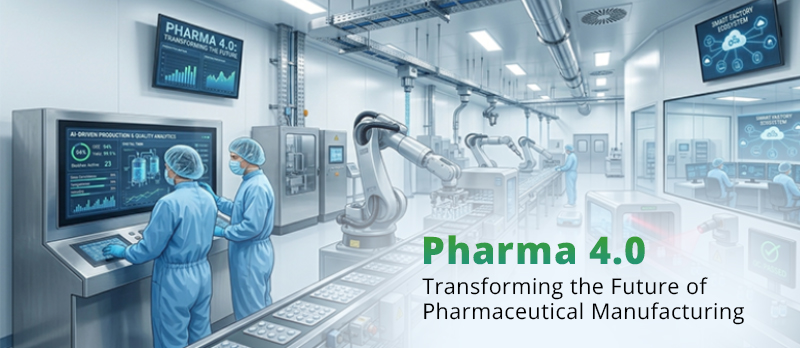
Pharma 4.0: Transforming the Future of Pharmaceutical Manufacturing
Pharma 4.0 is reshaping the pharmaceutical industry by integrating AI, IoT, and advanced analytics into manufacturing and operations. It enables real-time decision making, improves product quality, and accelerates time to market. As digital transformation becomes essential, pharma 4.0 is the foundation for building smarter, more efficient, and compliant pharmaceutical ecosystems.
See Contents
- 1 Overview
- 2 Accelerate Pharma 4.0 with Intelligent Manufacturing
- 3 What is Pharma 4.0
- 4 Key Technologies Driving Pharma 4.0
- 5 Benefits of Pharma 4.0
- 6 Pharma 4.0 in Manufacturing
- 7 Challenges in Implementing Pharma 4.0
- 8 The Future of Pharma 4.0
- 9 Why Pharma 4.0 Matters Now
- 10 Transform Operations with Pharma 4.0 Innovation
- 11 Conclusion
Overview
The pharmaceutical industry is undergoing a significant transformation driven by digital innovation, automation, and intelligent systems. At the center of this evolution lies pharma 4.0, a concept that integrates advanced technologies into pharmaceutical manufacturing to improve efficiency, quality, and compliance. As global demand for faster drug development and safer production increases, pharma 4.0 is no longer a futuristic idea but a present-day necessity.
Accelerate Pharma 4.0 with Intelligent Manufacturing
From AI-driven process optimization to real-time data monitoring, connected systems, and automated quality control, Pharma 4.0 is redefining pharmaceutical manufacturing. Connect with our experts to explore how advanced digital solutions can enhance efficiency, ensure compliance, and drive innovation across your pharma operations.
What is Pharma 4.0
Pharma 4.0 refers to the application of Industry 4.0 principles within the pharmaceutical sector. It combines technologies such as artificial intelligence, Internet of Things, cloud computing, robotics, and data analytics to create a connected and intelligent manufacturing ecosystem. The goal of pharma 4.0 is to enable real-time decision making, enhance product quality, and ensure regulatory compliance through digital transformation.
Unlike traditional pharmaceutical manufacturing, which often relies on manual processes and siloed systems, pharma 4.0 introduces a fully integrated digital framework. This allows organizations to move from reactive operations to predictive and proactive strategies.

Key Technologies Driving Pharma 4.0
Several advanced technologies form the backbone of pharma 4.0:
Artificial Intelligence and Machine Learning
Artificial Intelligence and Machine Learning form the intelligence layer of pharma 4.0, enabling pharmaceutical companies to move from reactive operations to predictive and prescriptive decision-making. AI algorithms can process vast volumes of structured and unstructured data generated across R&D, clinical trials, and manufacturing. This capability allows organizations to identify patterns, detect anomalies, and optimize processes in ways that were previously impossible.
In drug discovery, AI accelerates molecule identification, target validation, and simulation of drug interactions, significantly reducing time and cost. Within manufacturing, machine learning models continuously learn from production data to optimize batch parameters, improve yield, and reduce variability. AI-powered vision systems are also widely used in quality control to detect defects in packaging, labeling, and dosage forms with high precision.
Predictive maintenance is another critical application in pharma 4.0, where AI analyzes equipment performance data to forecast failures before they occur. This minimizes downtime, reduces maintenance costs, and ensures uninterrupted production. Overall, AI and ML bring intelligence, speed, and adaptability to pharmaceutical operations.
Internet of Things
The Internet of Things acts as the connectivity backbone of pharma 4.0, linking machines, sensors, and systems across the manufacturing ecosystem. IoT devices collect real-time data from production equipment, cleanroom environments, and supply chain operations, providing complete visibility into processes.
In pharmaceutical manufacturing, maintaining strict environmental conditions such as temperature, humidity, and air quality is critical. IoT sensors continuously monitor these parameters and trigger alerts if deviations occur, ensuring compliance with regulatory standards. This real-time monitoring helps maintain product integrity and patient safety.
IoT also enhances traceability by tracking raw materials, work-in-progress batches, and finished products throughout the production lifecycle. This level of transparency is essential for audits, recalls, and compliance reporting. Additionally, IoT-enabled smart equipment can communicate with other systems, enabling automated adjustments and synchronized workflows.
By enabling real-time insights and seamless communication, IoT plays a foundational role in building connected and intelligent pharma 4.0 environments.
Cloud Computing
Cloud computing provides the scalable and flexible infrastructure required to support pharma 4.0 initiatives. Pharmaceutical companies generate massive amounts of data across various functions, and cloud platforms enable efficient storage, processing, and access to this data from anywhere.
One of the key advantages of cloud computing in pharma 4.0 is data centralization. Instead of operating in silos, organizations can unify data from R&D, manufacturing, quality assurance, and supply chain into a single platform. This enables cross-functional collaboration and faster decision-making.
Cloud platforms also support advanced applications such as AI, machine learning, and analytics by providing the computational power needed to process large datasets. Additionally, cloud solutions offer built-in security features, compliance frameworks, and audit trails, which are essential for meeting stringent pharmaceutical regulations.
Another important aspect is scalability. As production demands grow or new technologies are introduced, cloud infrastructure can easily scale without requiring significant capital investment. This makes cloud computing a critical enabler of digital transformation in pharma 4.0.
Advanced Analytics
Advanced analytics transforms raw data into actionable insights, making it a key driver of pharma 4.0. By leveraging statistical models, predictive algorithms, and data visualization tools, pharmaceutical companies can gain a deeper understanding of their operations and identify opportunities for improvement.
In manufacturing, advanced analytics helps monitor process performance, detect deviations, and optimize production parameters. For example, real-time analytics can identify trends that indicate potential quality issues, allowing teams to take corrective actions before defects occur.
Predictive analytics is widely used to forecast demand, optimize inventory levels, and improve supply chain efficiency. This ensures that the right products are available at the right time while minimizing waste and overproduction.
Analytics also supports continuous improvement initiatives by providing insights into process efficiency, resource utilization, and operational bottlenecks. In a pharma 4.0 environment, decision-makers rely on data-driven insights rather than intuition, leading to more accurate and consistent outcomes.
Automation and Robotics
Automation and robotics are central to achieving the efficiency and precision required in pharma 4.0. By reducing reliance on manual processes, these technologies minimize human error, enhance consistency, and improve overall productivity.
Robotic systems are widely used in tasks such as material handling, packaging, labeling, and inspection. These systems can operate with high speed and accuracy, ensuring uniformity in production. In sterile environments, robotics also reduces the risk of contamination by limiting human intervention.
Automation extends beyond physical tasks to include process automation, where software systems manage workflows, approvals, and documentation. This is particularly important in maintaining compliance, as automated systems ensure that processes are executed consistently and records are accurately maintained.
In continuous manufacturing setups, automation enables seamless operations with minimal downtime. Machines communicate with each other, adjust parameters automatically, and maintain optimal performance without constant human oversight.
By integrating automation and robotics, pharma 4.0 creates highly efficient, reliable, and scalable manufacturing environments that meet the growing demands of the pharmaceutical industry.
Benefits of Pharma 4.0
The adoption of pharma 4.0 offers several advantages that directly impact business performance and patient outcomes:
Improved Product Quality
Pharma 4.0 ensures consistent quality by monitoring processes in real time and detecting deviations early.
Enhanced Regulatory Compliance
With built-in data tracking and audit trails, pharma 4.0 simplifies compliance with regulatory standards such as FDA and GMP requirements.
Operational Efficiency
Automation and data-driven insights reduce downtime, optimize resource utilization, and accelerate production cycles.
Faster Time to Market
Pharma 4.0 enables quicker drug development and manufacturing, helping companies respond to market demands more effectively.
Cost Reduction
By minimizing waste, improving efficiency, and preventing errors, pharma 4.0 helps reduce overall operational costs.

Pharma 4.0 in Manufacturing
Pharma 4.0 is revolutionizing manufacturing processes by introducing smart factories. These factories are equipped with connected systems that communicate with each other, ensuring seamless operations. Real-time data collection and analysis allow manufacturers to identify bottlenecks, predict equipment failures, and optimize workflows.
Continuous manufacturing is another important aspect of pharma 4.0. Unlike batch production, continuous manufacturing allows for uninterrupted production, improving efficiency and consistency. This approach aligns with the core principles of pharma 4.0, focusing on agility and scalability.
Challenges in Implementing Pharma 4.0
Despite its benefits, implementing pharma 4.0 comes with challenges:
High Initial Investment
The adoption of advanced technologies requires significant capital investment in infrastructure and training.
Data Integration Issues
Integrating legacy systems with modern digital platforms can be complex.
Regulatory Concerns
Ensuring compliance while adopting new technologies requires careful planning and validation.
Skill Gaps
Organizations need skilled professionals who understand both pharmaceutical processes and digital technologies to successfully implement pharma 4.0.
The Future of Pharma 4.0
The future of pharma 4.0 looks promising as more organizations embrace digital transformation. Emerging technologies such as digital twins, blockchain, and edge computing will further enhance the capabilities of pharma 4.0 systems.
Digital twins, for example, allow companies to create virtual replicas of manufacturing processes, enabling simulation and optimization. Blockchain technology can enhance transparency and security in supply chains. As these innovations mature, pharma 4.0 will continue to evolve, driving greater efficiency and innovation.
Why Pharma 4.0 Matters Now
The global healthcare landscape is changing rapidly, with increasing demand for personalized medicine, faster drug development, and higher quality standards. Pharma 4.0 provides the tools and framework needed to meet these demands.
By adopting pharma 4.0, pharmaceutical companies can stay competitive, improve patient outcomes, and build resilient supply chains. The shift towards pharma 4.0 is not just about technology but about redefining how the pharmaceutical industry operates in a digital age.
Transform Operations with Pharma 4.0 Innovation
Leverage connected systems, advanced analytics, and intelligent automation to unlock the full potential of Pharma 4.0. From predictive maintenance to continuous manufacturing and data-driven quality assurance, modern solutions are enabling smarter, faster, and more resilient pharmaceutical production.
Conclusion
Pharma 4.0 is transforming the pharmaceutical industry by integrating advanced technologies into every stage of the value chain. From drug discovery to manufacturing and distribution, pharma 4.0 enables smarter, faster, and more efficient processes.
Organizations that embrace pharma 4.0 today will be better positioned to navigate future challenges and opportunities. As the industry continues to evolve, pharma 4.0 will play a critical role in shaping a more innovative, efficient, and patient-centric pharmaceutical ecosystem.
Recommend finding details on GMP in pharma.