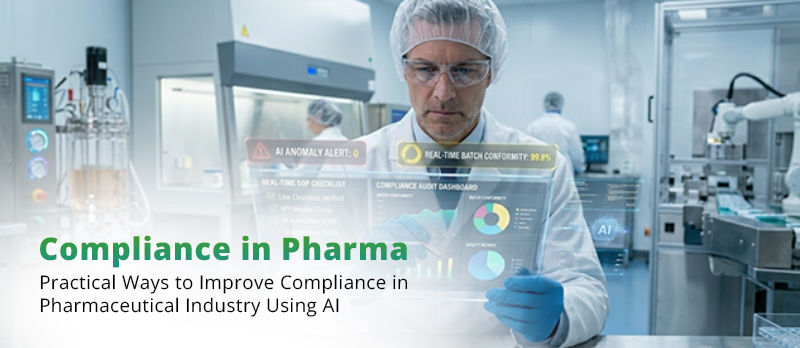
Compliance in Pharma, Practical Ways to Improve Compliance in Pharmaceutical Industry Using AI
Discover how AI transforms compliance in pharma and healthcare by improving efficiency, reducing risks, and enabling smarter decision-making
Compliance in pharma has always been a high-stakes function. It sits at the intersection of patient safety, regulatory adherence, operational discipline, and organizational accountability. Yet, despite strict frameworks and well-defined guidelines, compliance in the pharmaceutical industry continues to be one of the most complex and resource-intensive challenges. According to a report by McKinsey & Company, quality-related costs in pharma can account for up to 15–20% of total sales, with a significant portion driven by compliance activities and remediation efforts. In addition, findings from the U.S. Food and Drug Administration inspections consistently show recurring issues around data integrity, documentation gaps, and process deviations, highlighting systemic inefficiencies.
The reality is simple. Compliance is not failing because regulations are unclear. It is struggling because the systems, processes, and training models used to enforce it have not evolved at the same pace as the industry itself. A study by Deloitte notes that more than 60% of life sciences executives believe their compliance processes are overly manual and fragmented, limiting scalability and increasing risk exposure.
At the same time, healthcare organizations face similar issues. Understanding how to improve compliance in healthcare is no longer just about audits and documentation. It is about enabling people with the right knowledge at the right time, in the right format. According to PwC, nearly 45% of healthcare organizations report compliance challenges due to a lack of real-time access to critical information and inconsistent staff training.
This is where AI is beginning to redefine compliance in pharma and across the broader healthcare ecosystem. By enabling intelligent automation, contextual knowledge delivery, and predictive insights, AI is helping organizations move from reactive compliance models to proactive, continuous compliance systems.
See Contents
- 1 The Growing Complexity of Compliance in Pharma
- 2 Why Traditional Approaches to Compliance Are Not Enough
- 3 The Role of AI in Transforming Compliance in Pharma
- 4 Practical Steps to Improve Compliance in Pharma Using AI
- 5 Bringing the Steps Together
- 6 Make Compliance in Pharma Intelligent and Scalable
- 7 How AI Bridges the Gap Between Pharma and Healthcare Compliance
- 8 The Business Impact of AI-Driven Compliance
- 9 Bringing It All Together with Yuktra
- 10 Turn Compliance into a Competitive Advantage
- 11 Conclusion
The Growing Complexity of Compliance in Pharma
Compliance in the pharmaceutical industry is governed by a wide range of standards such as GMP, GxP, FDA regulations, and international frameworks. These regulations are essential, but they also introduce layers of complexity.
Some of the core challenges include:
- Constantly evolving regulatory requirements
- Manual and repetitive documentation processes
- Fragmented knowledge across teams and systems
- Inconsistent training and onboarding practices
- High dependency on human interpretation
Most organizations attempt to address these challenges by adding more processes, more documentation, and more audits. But this often creates friction rather than clarity.
To truly improve compliance in pharma, organizations need to shift from reactive compliance to proactive and intelligent compliance systems.
Why Traditional Approaches to Compliance Are Not Enough
Traditional compliance models rely heavily on static documentation, periodic training sessions, and retrospective audits. While these methods ensure baseline adherence, they fall short in dynamic environments.
Here is where the gap lies:
1. Knowledge Is Not Easily Accessible
Critical compliance information often exists in SOPs, PDFs, or internal systems that are difficult to navigate. Employees spend time searching rather than executing.
2. Training is one-time instead of Continuous
Most compliance training is conducted during onboarding or at scheduled intervals. This does not support real-time decision-making on the floor.
3. Human Error Remains a Major Risk
Even well-trained teams can make mistakes when processes are complex and documentation is extensive.
4. Audits Are Reactive
Issues are often identified after they occur, rather than being prevented in real time.
To address these gaps, organizations must rethink how compliance in the pharmaceutical industry is implemented and managed.

The Role of AI in Transforming Compliance in Pharma
AI introduces a fundamentally different approach. Instead of relying on static systems, AI enables dynamic, contextual, and intelligent compliance mechanisms.
Here are the key ways AI is helping improve compliance in healthcare and pharma:
a. Real-Time Knowledge Access
AI-powered systems can act as intelligent assistants that provide instant access to compliance-related information.
Instead of searching through documents, employees can simply ask questions and receive precise, contextual answers. This reduces dependency on memory and improves execution accuracy.
For example, an operator can ask about a cleaning SOP, a quality checklist, or a regulatory requirement and receive step-by-step guidance instantly.
This directly improves compliance in pharma by ensuring that the correct information is always available at the point of action.
b. Context-Aware Training and Guidance
AI enables continuous learning rather than one-time training.
By understanding user roles, tasks, and workflows, AI systems can deliver personalized guidance during actual operations. This ensures that employees are not just trained but supported in real time.
In the context of how to improve compliance in healthcare, this approach is critical. Healthcare professionals often operate in high-pressure environments where immediate access to accurate information can impact outcomes.
c. Automated Documentation and Record Keeping
Documentation is one of the most time-consuming aspects of compliance in the pharmaceutical industry.
AI can automate data capture, generate reports, and maintain audit-ready records with minimal manual effort. This reduces errors, saves time, and ensures consistency.
It also allows compliance teams to focus on higher-value activities such as risk assessment and process improvement.
d. Predictive Risk Identification
AI systems can analyze historical data, identify patterns, and predict potential compliance risks before they occur.
This shifts compliance from a reactive to a proactive function.
For instance, AI can flag deviations in processes, identify anomalies in production data, or highlight gaps in training. This allows organizations to take corrective actions early.
e. Multilingual and Inclusive Compliance Enablement
In many pharmaceutical and healthcare environments, teams are diverse and multilingual.
AI can deliver compliance guidance in multiple languages, ensuring that every employee clearly understands procedures and requirements.
This is a critical factor in improving compliance in healthcare, especially in global or distributed operations.
f. Seamless Integration Across Systems
AI can integrate with existing enterprise systems such as ERP, LIMS, and quality management platforms.
This creates a unified compliance ecosystem where information flows seamlessly across departments.
As a result, compliance in pharma becomes more streamlined, transparent, and efficient.

Practical Steps to Improve Compliance in Pharma Using AI
Implementing AI for compliance in pharma is not a plug-and-play initiative. It requires aligning technology with regulatory expectations, operational workflows, and human behavior. Each step in this journey should be approached with clarity, structure, and measurable outcomes.
Here is a deeper look at how organizations can effectively execute each step.
Step 1: Identify High-Impact Compliance Areas
Not all compliance challenges carry the same level of risk or urgency. The first step is to pinpoint where failures are most likely to occur or where the consequences are most severe.
This requires analyzing past audit findings, deviation reports, CAPA records, and inspection observations. Patterns usually emerge in areas such as batch manufacturing records, quality control procedures, data integrity, and regulatory submissions.
For example, if deviations frequently occur during manufacturing due to incorrect SOP execution, that becomes a high-impact area. Similarly, if audit observations highlight gaps in documentation or traceability, those areas should be prioritized.
AI can later be applied more effectively when it is focused on these critical zones. This targeted approach ensures faster ROI and minimizes disruption.
Step 2: Centralize Knowledge Sources
One of the biggest barriers to improving compliance in the pharmaceutical industry is fragmented knowledge. SOPs may exist in document management systems, training materials in LMS platforms, and regulatory guidelines in separate repositories.
This fragmentation leads to confusion, delays, and inconsistent execution.
Centralization does not just mean storing everything in one place. It means structuring knowledge in a way that is searchable, contextual, and usable.
Organizations should:
- Standardize document formats
- Tag and categorize compliance content
- Map SOPs to roles, processes, and departments
- Ensure version control and audit trails
AI systems rely heavily on structured data. Without this foundation, even the most advanced AI tools will struggle to deliver accurate results.
A well-centralized knowledge base becomes the backbone of AI-driven compliance.
Step 3: Deploy AI-Powered Assistants
Once knowledge is structured, the next step is to make it accessible in real time.
AI-powered assistants act as an interface between complex compliance information and the end user. Instead of navigating multiple systems, employees can interact with a single intelligent layer.
For instance:
- A production operator can ask for step-by-step instructions for a process
- A quality analyst can query acceptable limits or validation requirements
- A compliance officer can quickly retrieve regulatory guidelines
The key here is contextual intelligence. The AI should not just provide generic answers but should understand the user’s role, task, and environment.
This reduces errors, speeds up execution, and ensures that compliance is followed correctly at the point of action, not after the fact.
Step 4: Enable Continuous Learning
Traditional compliance training models are periodic and static. Employees attend sessions, complete assessments, and then return to their roles with limited ongoing support.
This approach does not align with the dynamic nature of pharma operations.
AI enables a shift toward continuous learning, where training is embedded into daily workflows.
This can include:
- On-demand microlearning modules triggered by tasks
- Real-time prompts and reminders during process execution
- Adaptive learning paths based on user performance
- Instant clarification of doubts through AI assistants
For example, if an employee is performing a rarely used procedure, the system can automatically provide guidance or reminders at each step.
This ensures that learning is not separated from execution. It becomes part of the workflow itself, which significantly improves compliance in pharma.
Step 5: Automate Repetitive Tasks
A large portion of compliance work involves repetitive and manual activities such as data entry, documentation, report generation, and validation checks.
These tasks are not only time-consuming but also prone to human error.
AI can automate many of these functions by:
- Capturing data directly from systems and equipment
- Generating standardized reports and logs
- Validating entries against predefined rules
- Flagging inconsistencies or missing information
For instance, batch records can be partially auto-generated, deviations can be flagged in real time, and compliance reports can be prepared with minimal manual intervention.
This reduces the administrative burden on teams and allows them to focus on critical thinking and decision-making.

Step 6: Monitor and Optimize
Compliance is not a one-time achievement. It is an ongoing process that requires continuous monitoring and improvement.
AI provides powerful analytics capabilities that go beyond traditional reporting.
Organizations can:
- Track compliance metrics in real time
- Identify trends and recurring issues
- Measure training effectiveness
- Analyze root causes of deviations
- Predict potential risks before they occur
For example, if a particular process consistently shows higher deviation rates, AI can highlight this trend and suggest corrective actions.
This creates a feedback loop where compliance systems are constantly refined and optimized.
Bringing the Steps Together
Each of these steps is interconnected. Identifying high-impact areas ensures focused implementation. Centralizing knowledge provides the foundation. AI assistants enable execution. Continuous learning reinforces behavior. Automation improves efficiency. Monitoring drives improvement.
When implemented together, these steps transform compliance in pharma from a reactive obligation into a proactive, intelligent system.
The end goal is not just to meet regulatory requirements but to create an environment where compliance becomes a natural outcome of well-designed processes and empowered employees.
Make Compliance in Pharma Intelligent and Scalable
Struggling with audits, documentation gaps, or inconsistent training? AI can bring real-time visibility, continuous learning, and automated compliance workflows into your operations. Discover how to improve compliance in healthcare and the pharmaceutical industry with smarter, connected systems.
How AI Bridges the Gap Between Pharma and Healthcare Compliance
While compliance in pharma and compliance in healthcare have distinct requirements, they share common challenges such as complexity, human dependency, and operational inefficiencies.
AI acts as a bridge by providing:
- Standardized yet flexible compliance frameworks
- Real-time decision support
- Scalable training and knowledge delivery
- Data-driven insights for continuous improvement
This unified approach helps organizations understand how to improve compliance in healthcare while maintaining strict adherence in pharmaceutical operations.
The Business Impact of AI-Driven Compliance
Adopting AI for compliance in the pharmaceutical industry delivers measurable benefits:
- Reduced compliance violations and risks
- Improved operational efficiency
- Faster audit readiness
- Enhanced employee productivity
- Better patient safety and outcomes
More importantly, it transforms compliance from a cost center into a strategic advantage.
Organizations that invest in intelligent compliance systems are better positioned to scale, innovate, and adapt to changing regulatory landscapes.
Bringing It All Together with Yuktra
As organizations look to modernize compliance in pharma, the need for an intelligent, scalable, and user-centric solution becomes clear.
This is where Yuktra plays a critical role.
Yuktra is designed as an AI-powered knowledge and compliance assistant that brings together training, execution, and regulatory adherence into a single unified layer. It enables organizations to move beyond static documentation and fragmented systems.
With Yuktra, employees can access SOPs, compliance guidelines, and operational knowledge instantly, in multiple languages, and in real time. It supports continuous learning, reduces dependency on manual processes, and ensures that compliance is embedded directly into daily workflows.
Whether it is guiding an operator through a process, helping a quality team prepare for audits, or supporting healthcare professionals with accurate information, Yuktra transforms how compliance is experienced and executed.
Turn Compliance into a Competitive Advantage
Stop treating compliance as a cost center. With AI-driven insights, real-time SOP guidance, and automated audit readiness, you can improve compliance in pharma while boosting efficiency and accuracy. See how intelligent systems can simplify regulatory complexity and empower your teams.
Conclusion
Compliance in pharma is no longer just about meeting regulatory requirements. It is about creating systems that enable accuracy, consistency, and efficiency at every level of the organization.
Traditional approaches, while necessary, are not sufficient to handle the growing complexity of the pharmaceutical industry and healthcare systems. The need of the hour is intelligent, proactive, and scalable compliance solutions.
AI provides a clear path forward. By enabling real-time knowledge access, continuous training, predictive insights, and automation, AI helps organizations understand how to improve compliance in healthcare and strengthen compliance in the pharmaceutical industry.
The shift is not just technological. It is strategic.
Organizations that embrace AI-driven compliance will not only reduce risks but also unlock new levels of productivity and operational excellence.
In this evolving landscape, solutions like Yuktra represent the next step in transforming compliance from a burden into a competitive advantage.
Recommend reading the details on Pharma 4.0: Transforming the Future of Pharmaceutical Manufacturing.