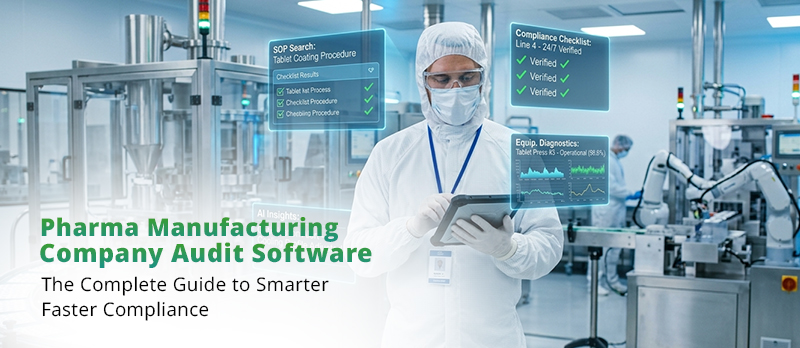
Pharma Manufacturing Company Audit Software, The Complete Guide to Smarter, Faster Compliance
Pharma manufacturing company audit software is transforming how pharmaceutical companies manage compliance, audits, and quality assurance. By replacing manual, paper-based processes with automated, real-time systems, this software enables faster audits, improved data integrity, and seamless CAPA management. In an industry where regulatory scrutiny is constantly increasing, adopting a digital audit solution is no longer optional but essential for maintaining GMP compliance, reducing risks, and ensuring continuous inspection readiness.
See Contents
- 1 Industry Stats: The Compliance Crisis by the Numbers
- 2 Simplify Audits with
- 3 Pharma Manufacturing Company Audit Software
- 4 What Is Pharma Manufacturing Company Audit Software?
- 5 Why Manual Audit Processes Are Failing Manufacturers
- 6 Core Features to Look For
- 6.1 Audit Planning & Scheduling
- 6.2 Digital Audit Checklists
- 6.3 CAPA Management
- 6.4 FDA 21 CFR Part 11 Compliance
- 6.5 Supplier & Vendor Audit Module
- 6.6 Real-Time Compliance Dashboard
- 6.7 Automated Report Generation
- 6.8 Risk-Based Audit Scoring
- 6.9 eQMS Integration
- 6.10 Document Control Linkage
- 6.11 Multi-Site Management
- 6.12 Mobile Audit Execution
- 7 Stay Inspection-Ready with Smart Audit Management
- 8 Types of Pharmaceutical Audits This Software Manages
- 9 Key Regulatory Standards Supported
- 10 Manual vs. Software-Driven Audit: A Direct Comparison
- 11 Implementation: A Step-by-Step Walkthrough
- 11.1 Step 1 – Needs Assessment & Gap Analysis
- 11.2 Step 2 – Vendor Selection & Risk Classification
- 11.3 Step 3 – User Requirements Specification (URS)
- 11.4 Step 4 – System Validation (IQ/OQ/PQ)
- 11.5 Step 5 – Data Migration & Master Data Setup
- 11.6 Step 6 – Training & Change Management
- 11.7 Step 7 – Go-Live & Hypercare Period
- 11.8 Step 8 – Periodic System Review
- 12 ROI and Business Impact
- 13 How to Choose the Right Solution
- 14 Choosing the Right Audit Software Starts Here
- 15 The Future of Pharmaceutical Audit Management
- 16 Final Verdict
- 17 Ready to Transform Your Audit Process?
- 18 FAQs: Pharma Manufacturing Company Audit Software
- 18.1 1. What is pharma manufacturing company audit software, and why is it important?
- 18.2 2. How does Yuktra enhance pharma audit management compared to traditional systems?
- 18.3 3. What are the key features of pharma manufacturing company audit software?
- 18.4 4. How does pharma audit software help with regulatory compliance?
- 18.5 5. What role does AI play in pharma manufacturing company audit software?
- 18.6 6. How does audit software improve CAPA management in pharma?
- 18.7 7. Can pharma audit software support multi-site manufacturing operations?
- 18.8 8. How does pharma audit software ensure data integrity?
- 18.9 9. What challenges can pharma companies face when implementing audit software?
- 18.10 10. How does pharma audit software improve audit efficiency?
- 18.11 11. What industries can benefit from pharma audit software like Yuktra?
- 18.12 12. How does pharma audit software support inspection readiness?
- 18.13 13. What is the future of pharma manufacturing company audit software?
- 18.14 14. How to choose the right pharma audit software?
- 18.15 15. Why should pharma companies invest in audit software now?
Industry Stats: The Compliance Crisis by the Numbers
The pharmaceutical manufacturing sector is under unprecedented regulatory pressure. Non-compliance is not just a legal risk; it is an existential financial threat. Before understanding what pharma manufacturing company audit software solves, consider the scale of the problem it addresses:
- $11B+ cost of pharmaceutical recalls globally in 2023 alone
- 66% of FDA 483 observations tied to documentation & audit failures
- 4x more warning letters issued per decade compared to the 1990s
- 73% reduction in audit cycle time reported by eQMS adopters
- $42 billion projected pharma QMS software market size by 2030
- 89% of top-50 pharma companies have deployed digital audit tools
These numbers paint a clear picture: pharmaceutical manufacturers that rely on spreadsheets, paper trails, and disconnected siloed systems are fighting a losing battle against an increasingly aggressive regulatory environment. The adoption of dedicated pharma manufacturing company audit software is no longer a competitive differentiator; it is a baseline operational requirement.
Simplify Audits with
Pharma Manufacturing Company Audit Software
Manual audits, delayed CAPAs, and compliance risks can slow down your pharma operations. It is time to move towards a smarter approach. With pharma manufacturing company audit software, you can automate audit workflows, ensure real-time compliance, improve data integrity, and stay inspection-ready at all times. Connect with our experts to see how intelligent audit solutions can transform your quality management system.
What Is Pharma Manufacturing Company Audit Software?
Pharma manufacturing company audit software is a specialized digital platform designed to plan, execute, track, and report on every type of audit conducted within or against a pharmaceutical manufacturing operation. It serves as the central nervous system for a company’s quality assurance (QA) and regulatory compliance infrastructure.
Unlike generic enterprise audit tools, pharmaceutical-grade audit software is built with deep domain knowledge of Good Manufacturing Practice (GMP) compliance, FDA 21 CFR Part 11 electronic records requirements, EudraLex Volume 4 (EU GMP), ICH Q10 pharmaceutical quality systems, and ISO 13485 (for combination products). The software integrates audit scheduling, observation logging, CAPA (Corrective and Preventive Action) management, risk scoring, supplier qualification, and regulatory submission-ready reporting into a single unified workflow.
At its core, pharma manufacturing company audit software transforms what was a reactive, document-heavy process into a proactive, data-driven quality intelligence system — enabling manufacturers to detect compliance gaps before regulators do.
Who Uses It?
The primary users within a pharmaceutical manufacturing company span multiple functions: Quality Assurance teams managing internal and external audit programs, Regulatory Affairs professionals preparing for FDA or EMA inspections, Supply Chain and Procurement teams conducting supplier and vendor audits, Manufacturing Operations leaders overseeing GMP adherence on the shop floor, and executive leadership monitoring enterprise-wide compliance dashboards.
Why Manual Audit Processes Are Failing Manufacturers
For decades, pharmaceutical manufacturers managed audits through a combination of paper checklists, Microsoft Excel trackers, shared network drives, and email chains. This approach — adequate in an era of infrequent inspections and limited product portfolios — has completely broken down under modern manufacturing complexity.
The Hidden Costs of Paper-Based Pharmaceutical Compliance Management
Manual pharmaceutical audit management creates compounding vulnerabilities that become catastrophically expensive when they surface during an FDA inspection or a WHO pre-qualification audit. Version control breakdowns mean auditors work off outdated checklists. Observation data sits fragmented across individual laptops. CAPA commitments are tracked in a separate spreadsheet that nobody updates. Evidence attachments are emailed rather than centrally stored. And audit reports take three to four weeks to compile, rather than being auto-generated the moment an audit closes.
“A single FDA Warning Letter can cost a mid-size pharmaceutical manufacturer between $50 million and $600 million in remediation, lost sales, and consent decree obligations. The majority are preventable through systematic audit documentation.”
— Pharmaceutical Compliance Research Institute, 2024 Industry Report
Beyond the financial risk, manual processes create a morale and efficiency drain on quality teams. QA professionals who should be engineering better quality systems spend their time chasing acknowledgement emails, reformatting spreadsheets, and manually escalating overdue CAPAs. Pharma manufacturing company audit software eliminates this operational drag.

Core Features to Look For
Not all pharmaceutical audit management software is built equally. When evaluating solutions, the following feature set distinguishes enterprise-grade platforms from lightweight checklisting tools:
Audit Planning & Scheduling
Calendar-based scheduling with risk-tiered frequency, resource allocation, and automated reminder workflows for all audit types.
Digital Audit Checklists
GMP-aligned, regulation-mapped checklist templates (FDA, EMA, WHO, ISO) with conditional logic, multi-media evidence capture, and offline mode.
CAPA Management
Root cause analysis tools, action item assignment with due dates, escalation paths, effectiveness verification tracking, and closure workflows.
FDA 21 CFR Part 11 Compliance
Full electronic audit trail, time-stamped e-signatures, access control hierarchy, and tamper-evident record locking.
Supplier & Vendor Audit Module
Approved vendor list integration, remote audit capabilities, risk-based supplier tiering, and qualification document management.
Real-Time Compliance Dashboard
KPI visualization for open findings, overdue CAPAs, audit completion rates, risk heatmaps, and regulatory submission readiness.
Automated Report Generation
Inspection-ready reports are auto-generated post-audit in regulatory format, with executive summaries, finding classifications, and trend analysis.
Risk-Based Audit Scoring
Automated risk scoring by observation severity (critical, major, minor), product impact, and regulatory precedent, driving intelligent prioritization.
eQMS Integration
Seamless bi-directional integration with SAP, Veeva Vault, MasterControl, TrackWise, and other enterprise quality management systems.
Document Control Linkage
Direct linkage of audit findings to SOPs, batch records, validation protocols, and regulatory submissions for end-to-end traceability.
Multi-Site Management
Centralized oversight across global manufacturing sites, contract manufacturing organizations (CMOs), and third-party labs with role-based access.
Mobile Audit Execution
Native iOS and Android apps enabling on-the-floor audits with barcode scanning, photo capture, and offline data sync.
Stay Inspection-Ready with Smart Audit Management
Regulatory pressure is increasing, and audit complexity is growing. Pharma manufacturing company audit software helps you stay ahead with automated audits, real-time insights, faster CAPA closure, and complete data traceability. Eliminate compliance gaps and build a future-ready quality system with intelligent audit solutions.
Types of Pharmaceutical Audits This Software Manages
A comprehensive pharma manufacturing company audit software solution is built to handle the full spectrum of audit types that a regulated manufacturer must conduct throughout the year. Each audit type carries distinct requirements, frequencies, and compliance implications.
Internal GMP Audits (Self-Inspections)
Regulatory bodies require pharmaceutical manufacturers to conduct periodic self-inspections to verify GMP compliance across all manufacturing areas. Audit software enables quality teams to schedule these at defined frequencies, assign qualified auditors, deploy standardized GMP checklists mapped to ICH Q10 and applicable national guidelines, and systematically track every finding to closure through structured CAPA workflows. The system maintains a perpetual internal audit calendar that accounts for product risk, previous finding history, and upcoming regulatory inspections.
Supplier and Vendor Qualification Audits
With supply chains spanning dozens of countries and hundreds of raw material, excipient, and packaging suppliers, pharmaceutical companies face immense vendor oversight challenges. Dedicated supplier audit modules within pharma manufacturing company audit software manage the full supplier qualification lifecycle: initial qualification, periodic requalification at risk-tiered intervals, for-cause audits triggered by quality complaints, and remote audit protocols — a capability that became mission-critical during and after the COVID-19 pandemic disruptions.
Mock Regulatory Inspections (Pre-Inspection Readiness)
Perhaps the highest-value use case is the ability to conduct structured mock FDA, EMA, PMDA, or WHO inspections using the software’s scenario-based audit templates. These pre-inspection readiness audits simulate the actual regulatory inspection process, allowing teams to identify documentation gaps, evidence retrieval weaknesses, and procedure deficiencies before regulators arrive on-site.
Contract Manufacturing Organization (CMO) Audits
For pharmaceutical companies that outsource manufacturing to CMOs or CDMOs, audit software provides a structured framework for conducting technical transfer audits, qualification audits, and ongoing surveillance audits against the contract manufacturing site. Cross-company collaboration portals allow both parties to track commitments, share documents, and close findings without breaching data confidentiality boundaries.
Laboratory and Analytical Audit Programs
Quality control laboratories within pharmaceutical manufacturing operations are subject to audit requirements under 21 CFR Part 211, USP General Chapter standards, and ISO/IEC 17025 for accredited labs. Audit software manages method validation audit trails, instrument calibration compliance tracking, analyst qualification records, and out-of-specification (OOS) investigation audit histories within the same unified platform.
Key Regulatory Standards Supported
An enterprise-grade pharma manufacturing company audit software platform must support compliance across the full landscape of applicable global regulatory frameworks simultaneously, given that most major manufacturers sell products into multiple regulated markets:
- FDA 21 CFR Parts 210 & 211 – Current GMP for finished pharmaceuticals, the primary US regulatory framework for manufacturing operations.
- FDA 21 CFR Part 11 – Electronic records and signatures govern audit trail integrity, e-signature validation, and data security requirements.
- EudraLex Volume 4 (EU GMP) – EU Good Manufacturing Practice guidelines including Annexes 1–21 covering sterile manufacturing, computerized systems, and QPs.
- ICH Q10 (PQS) – ICH’s Pharmaceutical Quality System guideline, the international framework for CAPA, change control, and audit programs.
- ISO 9001 & ISO 13485 – Quality management system standards applicable to combination products, medical device components, and general pharma operations.
- WHO GMP & PIC/S – World Health Organization and Pharmaceutical Inspection Co-operation Scheme standards for developing market and export compliance.
Manual vs. Software-Driven Audit: A Direct Comparison
Capability |
Manual/Paper Process |
Pharma Audit Software |
|---|---|---|
| Audit scheduling & reminders | Shared calendar + manual emails | Automated, risk-tiered scheduling |
| Checklist version control | Manual, error-prone | Centralized, locked, auto-versioned |
| Finding documentation | Handwritten or typed separately | In-app with photo/video evidence |
| CAPA tracking | Separate spreadsheet | Integrated, escalated, tracked |
| Report generation time | 2–4 weeks | Minutes, auto-generated |
| FDA 21 CFR Part 11 compliance | Not achievable | Native, validated |
| Multi-site visibility | Fragmented siloes | Real-time enterprise dashboard |
| Regulatory inspection readiness | Reactive, days of scrambling | Always-on readiness score |
| Trend analysis & predictive risk | Not feasible manually | AI-powered pattern detection |

Implementation: A Step-by-Step Walkthrough
Implementing pharma manufacturing company audit software is a validated system deployment — not a standard IT rollout. Regulatory expectations require that computerized systems used in GMP environments be validated in accordance with GAMP 5 (Good Automated Manufacturing Practice) guidelines and applicable 21 CFR Part 11 or EU Annex 11 requirements. A structured implementation follows these phases:
Step 1 – Needs Assessment & Gap Analysis
Map your current audit program against regulatory requirements. Identify gaps in coverage, documentation standards, CAPA closure rates, and inspection history findings that the software must address.
Step 2 – Vendor Selection & Risk Classification
Evaluate vendors against GAMP 5 software categories, validation documentation packages available, 21 CFR Part 11 compliance certification, and reference customer base in comparable manufacturing environments.
Step 3 – User Requirements Specification (URS)
Document functional and non-functional requirements that the system must meet to satisfy your QMS and regulatory obligations. The URS becomes the foundation of your validation protocol.
Step 4 – System Validation (IQ/OQ/PQ)
Execute Installation Qualification (IQ), Operational Qualification (OQ), and Performance Qualification (PQ) protocols as required by GAMP 5, generating a complete validation package suitable for regulatory review.
Step 5 – Data Migration & Master Data Setup
Transfer historical audit records, approved vendor lists, CAPA histories, and regulatory submission data into the new system with full data integrity verification.
Step 6 – Training & Change Management
Deliver role-based training to QA personnel, auditors, department heads, and executive reviewers. Training records are captured within the system itself as part of the validation record.
Step 7 – Go-Live & Hypercare Period
Operate under intensified monitoring for the first 90 days, capturing any performance deviations, executing post-implementation change controls, and establishing your baseline compliance KPIs.
Step 8 – Periodic System Review
Conduct annual system reviews per GAMP 5 guidance to maintain validated status, assess regulatory update alignment, and evaluate software upgrade impacts.
ROI and Business Impact
Investment in pharma manufacturing company audit software delivers measurable, quantifiable returns across multiple dimensions. Organizations that have deployed enterprise pharmaceutical audit management software consistently report the following outcomes within 12–24 months of full deployment:
- 73% Reduction in audit cycle time from planning to report closure
- 68% Decrease in CAPA overdue rate within first year
- 55% Fewer repeat findings across consecutive audit cycles
- 40% Reduction in time QA staff spend on administrative audit tasks
- 3x Faster FDA inspection data room preparation vs. paper systems
- 82% Of adopters report improved first-pass inspection outcomes
Beyond these operational metrics, the risk mitigation value is arguably even more significant. A single avoided FDA Warning Letter, with its associated consent decree risk, remediation costs, and product hold implications, can justify the entire multi-year cost of an enterprise pharmaceutical audit management platform. When assessed against the backdrop of a single costly recall or regulatory action, the ROI calculation becomes straightforward.
How to Choose the Right Solution
The pharmaceutical compliance software market is crowded with solutions ranging from standalone audit checklisting apps to fully integrated enterprise eQMS platforms. Evaluating the right pharma manufacturing company audit software for your organization requires assessing these critical decision factors:
Validation Documentation Availability
This is non-negotiable. Vendors must supply a complete validation documentation package (Installation Qualification, Operational Qualification, and Performance Qualification protocols and reports) alongside their Software Design Specification and GAMP 5 category classification. Any vendor unable to produce these on request is not suitable for GMP pharmaceutical environments.
Regulatory Intelligence Updates
Regulations evolve. FDA guidance updates, EU Annex revisions, and ICH guideline amendments must be reflected in the software’s audit templates, checklists, and reporting frameworks. Evaluate how frequently the vendor updates regulatory content, through what mechanism, and whether updates trigger re-validation obligations that would create operational disruption.
Integration Architecture
Audit software does not operate in isolation. Evaluate the depth and maturity of integrations with your existing ERP (SAP, Oracle), LIMS (LabVantage, STARLIMS), document management (Veeva Vault, OpenText Documentum), and training management systems. Poor integration leads to duplicate data entry, which undermines data integrity — a core GMP requirement.
Cloud vs. On-Premise Deployment
Cloud-hosted pharmaceutical audit software (SaaS model) now dominates new deployments due to lower total cost of ownership, vendor-managed infrastructure qualification, and accelerated implementation timelines. However, certain highly regulated markets, classified manufacturing environments, or organizations with strict data sovereignty requirements may still mandate on-premise or private cloud deployments.
Vendor Track Record in Pharma
Unlike horizontal enterprise software, pharma manufacturing company audit software requires deep domain expertise. Evaluate vendors’ reference customer base in your manufacturing segment (small molecule, biologics, sterile, API, etc.), their participation in industry associations such as PIC/S, ISPE, and PDA, and their responsiveness during any recent major regulatory guideline change.
Choosing the Right Audit Software Starts Here
Not all pharma manufacturing company audit software is built the same. Before you decide, understand what features, integrations, and compliance capabilities truly matter for your operations. Our experts can guide you in selecting a solution that fits your quality goals, scales with your growth, and keeps you fully audit-ready.
The Future of Pharmaceutical Audit Management
The future is not coming.
It is already here.
Pharma manufacturing company audit software is evolving fast.
It is changing how audits are planned, executed, and improved.
What was once manual, periodic, and reactive is now becoming intelligent, continuous, and predictive. This shift is not optional. It is being driven by stricter regulations, growing operational complexity, and the need for real-time decision-making in pharmaceutical manufacturing.
AI-Powered Predictive Compliance
No more surprises.
- Detect risks before audits happen
- Analyze past audit findings automatically
- Identify hidden patterns in data
- Get early warning signals
Move from reactive → proactive compliance.
Modern pharma manufacturing company audit software uses AI to study historical data such as deviations, CAPAs, and inspection outcomes. This allows quality teams to focus on high-risk areas even before an audit begins, reducing the chances of non-compliance.
Remote and Hybrid Audits
Audits are no longer limited to site visits.
- Conduct audits from anywhere
- Use live video for real-time inspections
- Enable AR-based virtual walkthroughs
- Monitor environments via IoT data
- Collaborate with CMOs securely
Faster audits.
Lower costs.
Wider visibility.
With global operations becoming the norm, remote audit capabilities are now a critical feature of pharma manufacturing company audit software. Regulatory bodies have also adapted, making hybrid audits a practical and accepted approach.
Continuous Monitoring (Not Periodic Audits)
Why wait for annual audits?
- Track compliance in real time
- Integrate with MES, LIMS, and other systems
- Get continuous audit readiness
- Eliminate last-minute audit stress
Shift from once-a-year audits → always-on compliance.
Instead of relying on scheduled audits, companies are now using audit software to continuously monitor operations. This ensures that compliance gaps are identified and resolved instantly, not months later.
Blockchain for Data Integrity
Trust your audit data. Completely.
- Create tamper-proof audit trails
- Ensure full traceability
- Meet 21 CFR Part 11 requirements
- Strengthen inspection confidence
Data becomes immutable. Verifiable. Secure.
Emerging technologies like blockchain are adding another layer of trust to pharma manufacturing company audit software. This ensures that audit records cannot be altered, making compliance stronger and more transparent during inspections.
What This Means for You
- Fewer compliance risks
- Faster audit cycles
- Better inspection outcomes
- Stronger quality systems
The direction is clear.
Pharma companies that adopt advanced pharma manufacturing company audit software will move faster, stay compliant, and reduce risk. Those who delay will continue to struggle with inefficiencies and regulatory pressure.
This is not just evolution.
It is a complete shift in how pharma audits work.
Final Verdict
Pharma manufacturing company audit software is no longer just a convenience; it is now essential for compliance. With rising global regulations, complex operations, and heavy manual workloads, digital audit systems have become as critical as ERP or LIMS platforms.
The real value is not just efficiency but risk reduction. It helps prevent missed CAPAs, undocumented issues, inconsistent audits, and costly consequences like FDA warning letters or product recalls.
Ready to Transform Your Audit Process?
The future of compliance is digital, proactive, and continuous. Pharma manufacturing company audit software empowers you to eliminate risks, streamline audits, and maintain complete inspection readiness. Do not wait for the next audit to expose gaps. Take control of your quality systems today with a smarter, more efficient approach.
Companies using pharmaceutical compliance management software and audit platforms within their Quality Management System achieve better inspection results, faster audits, and higher CAPA closure rates than those relying on manual methods.
Whether you are a global manufacturer, a CDMO, or a growing pharma company preparing for inspections, investing in pharma manufacturing company audit software is a smart and necessary risk management decision.
Also, read details on Pharma 4.0: Transforming the Future of Pharmaceutical Manufacturing
FAQs: Pharma Manufacturing Company Audit Software
1. What is pharma manufacturing company audit software, and why is it important?
Pharma manufacturing company audit software is a digital solution designed to manage, automate, and streamline audit processes within pharmaceutical manufacturing environments. It replaces manual, paper-based systems with structured, traceable, and real-time audit workflows. This software is critical because pharmaceutical companies operate under strict regulatory frameworks such as GMP, FDA guidelines, and 21 CFR Part 11. Any compliance gap can lead to severe consequences including warning letters, product recalls, or even plant shutdowns.
Platforms like Yuktra take this a step further by integrating audit workflows with intelligent systems that enable faster SOP access, real-time audit tracking, and multilingual assistance for operators. This ensures that audits are not just a periodic activity but part of continuous compliance.
By using pharma manufacturing company audit software, organizations improve audit accuracy, reduce human errors, ensure data integrity, and maintain complete inspection readiness. It transforms audits from reactive processes into proactive compliance strategies, which is essential in today’s highly regulated pharma ecosystem.
2. How does Yuktra enhance pharma audit management compared to traditional systems?
Traditional audit systems in pharma rely heavily on manual documentation, spreadsheets, and fragmented communication. This leads to delays, inconsistencies, and a lack of real-time visibility into compliance status. Yuktra enhances pharma audit management by introducing a unified, AI-powered platform that connects audit processes with SOPs, training, and operational intelligence.
With Yuktra, audit teams can instantly search SOPs, track audit findings, and initiate CAPA actions without switching systems. It also enables multilingual access, ensuring that operators across different regions understand compliance requirements clearly. This is especially important in large-scale pharmaceutical manufacturing environments.
Unlike traditional systems, Yuktra supports real-time audit monitoring and intelligent insights, helping teams identify risks before they escalate. It also integrates seamlessly with existing systems, reducing the friction of digital transformation.
By leveraging Yuktra within pharma manufacturing company audit software, companies can significantly improve audit efficiency, ensure regulatory compliance, and create a more connected and intelligent quality management ecosystem.
3. What are the key features of pharma manufacturing company audit software?
Pharma manufacturing company audit software comes with a wide range of features designed to ensure compliance, efficiency, and traceability. Core features include digital audit checklists, automated audit scheduling, real-time reporting dashboards, CAPA management, document control, and audit trail tracking. These features ensure that every audit activity is recorded, monitored, and easily accessible.
Advanced platforms like Yuktra add intelligent capabilities such as instant SOP retrieval, AI-driven insights, and multilingual support. This enhances usability across diverse teams and reduces dependency on manual processes. Yuktra also enables quick training module generation, ensuring that audit findings are immediately translated into actionable learning.
Other important features include risk-based audit planning, mobile audit capabilities, and integration with systems like MES and LIMS. These features ensure that audits are not isolated activities but part of a larger digital ecosystem.
Overall, pharma manufacturing company audit software with solutions like Yuktra ensures that audits are faster, more accurate, and aligned with regulatory expectations while improving overall quality management.
4. How does pharma audit software help with regulatory compliance?
Regulatory compliance in pharmaceutical manufacturing requires strict adherence to guidelines such as GMP, FDA regulations, and data integrity standards. Pharma manufacturing company audit software helps organizations meet these requirements by providing structured workflows, automated documentation, and complete audit traceability.
With platforms like Yuktra, compliance becomes more proactive. The system ensures that SOPs are easily accessible, audit trails are securely maintained, and deviations are tracked in real time. This reduces the risk of non-compliance and ensures that all regulatory requirements are consistently met.
Audit software also simplifies the process of preparing for inspections. Instead of scrambling to gather documents, companies can provide auditors with instant access to digital records. Yuktra enhances this by enabling quick retrieval of relevant SOPs and audit data, even in multilingual formats.
By integrating compliance into daily operations, pharma manufacturing company audit software ensures that organizations are always inspection-ready, reducing the stress and risks associated with regulatory audits.
5. What role does AI play in pharma manufacturing company audit software?
AI is transforming pharma manufacturing company audit software by enabling predictive and intelligent audit management. Instead of relying solely on historical data and manual analysis, AI-powered systems can identify patterns, detect anomalies, and predict potential compliance risks.
Yuktra leverages AI to enhance audit processes by providing intelligent SOP search, automated insights, and real-time recommendations. This allows audit teams to focus on high-risk areas and take preventive actions before issues escalate.
AI also improves efficiency by automating repetitive tasks such as data analysis, report generation, and audit scheduling. It reduces human error and ensures consistency across audit processes. In addition, AI-driven systems can continuously learn from past audits, making future audits more accurate and effective.
By integrating AI into pharma manufacturing company audit software, solutions like Yuktra enable organizations to move from reactive compliance to proactive risk management, significantly improving audit outcomes and operational efficiency.
6. How does audit software improve CAPA management in pharma?
CAPA management is a critical component of pharmaceutical quality systems. Delays or inefficiencies in CAPA processes can lead to compliance issues and repeated audit findings. Pharma manufacturing company audit software improves CAPA management by automating workflows, tracking progress, and ensuring timely closure.
With Yuktra, CAPA processes become more streamlined and transparent. Audit findings can be directly linked to corrective actions, and teams can monitor progress in real time. Yuktra also enables quick access to relevant SOPs and training materials, ensuring that corrective actions are implemented correctly.
The software provides alerts and reminders, reducing the risk of missed deadlines. It also maintains a complete audit trail, ensuring that all CAPA activities are documented and compliant with regulatory requirements.
By integrating CAPA management into pharma manufacturing company audit software, platforms like Yuktra ensure faster resolution of issues, improved accountability, and better overall compliance outcomes.
7. Can pharma audit software support multi-site manufacturing operations?
Yes, modern pharma manufacturing company audit software is designed to support multi-site operations. Pharmaceutical companies often operate across multiple locations, making it challenging to maintain consistent audit standards and compliance.
Yuktra enables centralized audit management across all sites while allowing localized execution. This ensures that all facilities follow the same audit protocols while accommodating regional requirements. The platform provides real-time visibility into audit activities across sites, enabling better coordination and decision-making.
With features like multilingual support, Yuktra ensures that teams in different regions can easily understand and follow audit procedures. It also enables secure data sharing and collaboration, which is essential for global operations.
By using pharma manufacturing company audit software like Yuktra, organizations can standardize audit processes, improve consistency, and ensure compliance across all manufacturing sites.
8. How does pharma audit software ensure data integrity?
Data integrity is a key requirement in pharmaceutical manufacturing. Pharma manufacturing company audit software ensures data integrity by maintaining secure, tamper-proof records and complete audit trails.
Yuktra enhances data integrity by providing structured data capture, automated documentation, and secure storage. Every action within the system is recorded, ensuring full traceability. This is essential for meeting regulatory requirements such as 21 CFR Part 11.
The software also minimizes manual data entry, reducing the risk of errors. With real-time validation and automated checks, it ensures that all data is accurate and consistent. Yuktra further strengthens data integrity by enabling quick retrieval of records, ensuring transparency during audits.
By integrating robust data management capabilities, pharma manufacturing company audit software ensures that organizations can maintain high standards of data integrity and compliance.
9. What challenges can pharma companies face when implementing audit software?
Implementing pharma manufacturing company audit software can come with challenges such as resistance to change, integration with legacy systems, and user adoption issues. Employees accustomed to manual processes may find it difficult to transition to digital systems.
Yuktra addresses these challenges by offering an intuitive interface and seamless integration capabilities. Its multilingual support ensures that users across different regions can easily adapt to the system. Training modules generated within Yuktra also help users quickly understand and adopt new workflows.
Another challenge is data migration. Moving from paper-based systems to digital platforms requires careful planning. Yuktra simplifies this process by providing structured data management and migration support.
By addressing these challenges effectively, pharma manufacturing company audit software like Yuktra ensures a smooth transition to digital audit management.
10. How does pharma audit software improve audit efficiency?
Pharma manufacturing company audit software improves audit efficiency by automating repetitive tasks, reducing manual errors, and enabling real-time collaboration. Audit planning, execution, and reporting become faster and more streamlined.
Yuktra enhances efficiency by providing instant access to SOPs, automated audit workflows, and real-time insights. This reduces the time spent on searching for documents and analyzing data. Teams can focus on critical tasks rather than administrative work.
The software also enables mobile audits, allowing auditors to capture data on the go. Real-time dashboards provide visibility into audit progress, helping teams make informed decisions quickly.
By using pharma manufacturing company audit software like Yuktra, organizations can significantly reduce audit cycle times and improve overall productivity.
11. What industries can benefit from pharma audit software like Yuktra?
While pharma manufacturing company audit software is primarily designed for pharmaceutical companies, it can also benefit other regulated industries such as biotechnology, medical devices, and chemicals.
Yuktra is particularly versatile as it is built to support various use cases beyond pharma. Its ability to manage SOPs, audits, and training makes it suitable for any industry that requires strict compliance and quality management.
In pharmaceutical manufacturing, Yuktra ensures compliance with GMP and regulatory standards. In other industries, it helps maintain operational efficiency and compliance with industry-specific guidelines.
By offering a flexible and scalable solution, pharma manufacturing company audit software like Yuktra can be adapted to meet the needs of different industries.
12. How does pharma audit software support inspection readiness?
Inspection readiness is crucial in pharmaceutical manufacturing. Pharma manufacturing company audit software ensures that organizations are always prepared for regulatory inspections.
Yuktra plays a key role by providing instant access to audit records, SOPs, and compliance data. This eliminates the need for last-minute preparations and reduces stress during inspections. The platform also ensures that all audit activities are documented and easily accessible.
Real-time monitoring and automated alerts help identify and resolve issues before they become compliance risks. Yuktra’s intelligent features ensure that teams are always aware of their compliance status.
By using pharma manufacturing company audit software like Yuktra, organizations can maintain continuous inspection readiness and improve their chances of successful audits.
13. What is the future of pharma manufacturing company audit software?
The future of pharma manufacturing company audit software lies in advanced technologies such as AI, blockchain, and continuous monitoring. These technologies will make audits more predictive, transparent, and efficient.
Yuktra is already aligning with these trends by integrating AI-powered insights and real-time monitoring capabilities. This enables organizations to move towards proactive compliance and continuous audit readiness.
Future developments may include blockchain-based audit trails, providing tamper-proof records and enhanced data integrity. Continuous monitoring systems will replace periodic audits, ensuring real-time compliance.
By adopting innovative solutions like Yuktra, pharmaceutical companies can stay ahead of these trends and build a future-ready audit management system.
14. How to choose the right pharma audit software?
Choosing the right pharma manufacturing company audit software requires careful consideration of features, scalability, and compliance capabilities. Organizations should look for solutions that offer automation, real-time insights, and seamless integration with existing systems.
Yuktra stands out by providing a comprehensive platform that combines audit management with SOP access, training, and AI-driven insights. Its multilingual support and user-friendly interface make it suitable for diverse teams.
Other factors to consider include vendor expertise, customization options, and regulatory compliance. Yuktra’s ability to adapt to different use cases and industries makes it a strong choice.
By selecting the right software, organizations can improve audit efficiency, ensure compliance, and achieve better quality outcomes.
15. Why should pharma companies invest in audit software now?
Pharma companies should invest in pharma manufacturing company audit software now because regulatory requirements are becoming stricter, and audit complexity is increasing. Delaying digital transformation can lead to compliance risks and operational inefficiencies.
Yuktra provides a modern solution that helps organizations stay ahead of regulatory demands. Its intelligent features enable proactive compliance, faster audits, and improved data integrity. This reduces the risk of costly penalties and enhances overall quality management.
Investing in audit software also provides a competitive advantage. Companies that adopt digital solutions can operate more efficiently and respond quickly to regulatory changes.
By choosing pharma manufacturing company audit software like Yuktra, organizations can future-proof their operations and ensure long-term success.