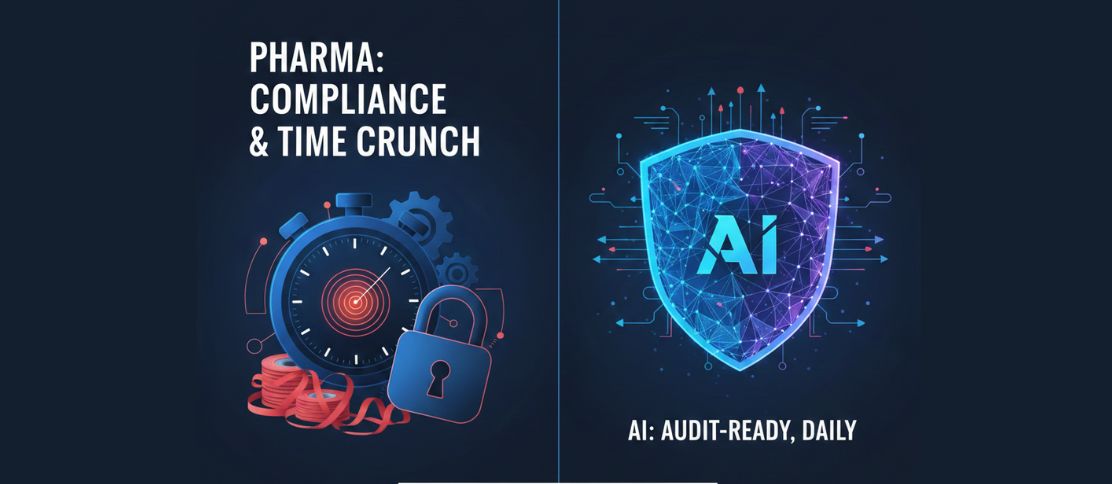
Pharma Compliance Is Not Just a Regulatory Challenge. It Is a Time Crisis. Why AI Is the Only Sustainable Solution
Explore how AI is redefining pharma compliance, enabling smarter oversight, greater operational resilience, and a future ready regulatory framework built for scale.
Pharma compliance has always been associated with regulations, inspections, and documentation. Most discussions around pharma compliance focus on regulatory frameworks, warning letters, audit observations, and corrective actions. But there is a deeper issue that is often ignored.
Across manufacturing plants, quality units, regulatory affairs departments, and validation teams, professionals are not struggling because they do not understand the rules. They are struggling because there are not enough hours in the day to execute every compliance requirement with precision, consistency, and speed.
This is where AI is emerging as the only sustainable solution. Not as a replacement for quality professionals, but as a system that removes the time bottleneck inside pharma compliance operations.
See Contents
- 1 Understanding the True Nature of Pharma Compliance
- 2 Ready to Strengthen Your Pharma Compliance with AI?
- 3 Why Pharma Compliance Has Become a Time Crisis
- 4 The Difference Between Compliant and Continuously Audit-Ready
- 5 How AI Solves the Time Problem in Pharma Compliance
- 6 Validation and AI in GxP Environments
- 7 Strategic Benefits of AI-Driven Pharma Compliance
- 8 The Future of Pharma Compliance Is Continuous and Intelligent
- 9 Ready to Strengthen Your Pharma Compliance with AI?
- 10 Conclusion: AI Is the Only Sustainable Solution
- 11 FAQ
- 11.1 1. Why is pharma compliance increasingly being seen as a time crisis rather than just a regulatory requirement?
- 11.2 2. How do traditional compliance systems fail in managing time-sensitive operations in pharma?
- 11.3 3. Why is AI considered the only sustainable solution for modern pharma compliance challenges?
- 11.4 4. How does Yuktra reduce deviations caused by human error in pharma operations?
- 11.5 5. Can AI-driven compliance systems like Yuktra improve audit readiness?
- 11.6 6. How does Yuktra support continuous training in a high-pressure pharma environment?
- 11.7 7. What role does real-time data play in solving the compliance time crisis?
- 11.8 8. How does Yuktra ensure consistency across multiple manufacturing sites?
- 11.9 9. Is AI adoption in pharma compliance complex and time-consuming?
- 11.10 10. What is the future of pharma compliance with AI solutions like Yuktra?
Understanding the True Nature of Pharma Compliance
At its core, pharma compliance ensures that every product released to patients is safe, effective, and manufactured under controlled conditions. It spans Good Manufacturing Practices, Good Clinical Practices, Good Laboratory Practices, electronic records requirements, data integrity controls, and global regulatory standards.
Pharma compliance covers:
- Batch record review and release
- Deviation investigation and root cause analysis
- Corrective and Preventive Actions management
- Change control oversight
- Supplier qualification and monitoring
- Validation of equipment, systems, and processes
- Electronic records and audit trail integrity
- Employee training and role-based qualification
Each of these areas requires documentation, traceability, approvals, and monitoring. The complexity is intentional because patient safety depends on it.
However, the volume of work required to maintain pharma compliance has grown dramatically in the last decade.
Manufacturing has become more digitized. Data generation has increased exponentially. Global supply chains have expanded. Regulatory inspections are more data-driven. Expectations for transparency and traceability are higher than ever.
Pharma compliance today is not just about meeting regulations. It is about keeping up with the pace of regulated operations.
Ready to Strengthen Your Pharma Compliance with AI?
Build a resilient, future-ready compliance ecosystem designed to handle increasing regulatory pressure with intelligence and scale.
Schedule a Consultation Now!
Why Pharma Compliance Has Become a Time Crisis
The biggest misconception is that pharma compliance failures happen because teams lack knowledge. In reality, most compliance gaps occur because time runs out.
Consider the operational reality inside a pharmaceutical company.
Every production batch generates documentation that must be reviewed. Every deviation must be investigated within defined timelines. Also, every CAPA must be tracked until closure.
Every SOP must be reviewed periodically. Every system update requires validation documentation. Additionally, every employee must maintain up-to-date training records.
Now multiply that by multiple product lines, multiple manufacturing sites, global distribution networks, and continuous inspections.
The workload compounds quickly.
Quality teams are often responsible for reviewing thousands of pages of documentation each month. Manual review processes consume significant time. Spreadsheet tracking systems require constant updates. Email-based workflows create delays and miscommunication.
Pharma compliance becomes reactive instead of proactive.
Instead of continuously monitoring risks, teams scramble before inspections. Instead of analyzing trends in real time, they generate quarterly reports. Also, instead of preventing compliance drift, they correct it after it happens.
This is not a failure of discipline. It is a failure of time capacity.
Pharma compliance requires constant vigilance, but human bandwidth is limited.
The Difference Between Compliant and Continuously Audit-Ready
There is an important distinction in pharma compliance: being compliant versus being continuously audit-ready.
Many organizations operate in cycles. For most of the year, compliance activities proceed at a steady pace. When the inspection notice arrives, the intensity increases dramatically. Open CAPAs are reviewed urgently. Training records are reconciled. Audit trails are double-checked. Documentation gaps are closed.
During that period, pharma compliance looks strong.
But this surge model is unsustainable. It creates stress, burnout, and hidden risk.
Continuous audit readiness means that on any given day, documentation is current, deviations are under control, CAPAs are progressing on time, and training compliance is intact. It means that inspection preparation does not require emergency mobilization.
Achieving this level of pharma compliance manually is extremely difficult in modern high-volume environments.
This is where AI becomes critical.
How AI Solves the Time Problem in Pharma Compliance
AI does not interpret regulations independently or make regulatory decisions without oversight. Instead, AI reduces the time burden associated with monitoring, tracking, and analyzing compliance data.
Here are the technical areas where AI transforms pharma compliance.
1. Intelligent CAPA Management
Corrective and Preventive Actions are central to pharma compliance. Each CAPA has deadlines, root cause documentation, impact assessments, and verification steps.
AI systems can:
- Continuously monitor open CAPAs and flag aging risks
- Predict which CAPAs are likely to miss deadlines based on historical patterns
- Detect recurring root causes across departments
- Prioritize high-risk CAPAs for leadership attention
Using machine learning models trained on historical deviation and CAPA datasets, organizations can move from reactive closure to predictive oversight.
This strengthens pharma compliance by preventing backlog accumulation and reducing repeat observations.
2. Real-Time Deviation Trend Analysis
Traditional deviation trend analysis is periodic. AI makes it continuous.
By applying pattern recognition and anomaly detection algorithms to deviation databases, AI can identify:
- Recurring equipment-related deviations
- Operator-specific trends
- Process drift over time
- Cross-site systemic issues
Instead of waiting for quarterly reviews, pharma compliance teams receive real-time alerts when deviation clusters begin forming.
This reduces regulatory risk and supports preventive action.
3. Automated Document Control and SOP Monitoring
Document control is one of the most time-consuming aspects of pharma compliance.
AI-powered systems can:
- Monitor document review cycles automatically
- Detect inconsistencies between active processes and approved procedures
- Flag outdated SOP references within batch records
- Route documents for review based on risk prioritization
Natural language processing can analyze document content and identify missing elements required under regulatory standards.
This ensures pharma compliance documentation remains accurate and synchronized without constant manual supervision.
4. Audit Trail Monitoring and Data Integrity Surveillance
Regulations require secure electronic records and tamper-evident audit trails.
AI systems can analyze large volumes of audit trail logs to detect:
- Unusual access patterns
- Backdated entries
- Unauthorized data modifications
- Suspicious deletion patterns
Using anomaly detection models, AI highlights risks that human reviewers may overlook due to scale.
Data integrity is a core pillar of pharma compliance, and AI strengthens it by operating continuously.
5. Training Compliance Automation
Training management directly impacts pharma compliance. An unqualified employee performing regulated tasks can lead to inspection findings.
AI-integrated learning management systems can:
- Map job roles to required training automatically
- Identify gaps in certification
- Prevent task assignments if training is expired
- Predict upcoming training bottlenecks
This ensures that training compliance is maintained daily rather than corrected before audits.
Follow the link to check details on Key GxP and Regulatory Compliance Requirements for Pharma Software.
Validation and AI in GxP Environments
One common concern is whether AI can operate within GxP-regulated environments.
The answer lies in validation.
AI systems used in pharma compliance must undergo validation similar to other computerized systems. This includes:
- User Requirement Specifications
- Functional Specifications
- Installation Qualification
- Operational Qualification
- Performance Qualification
- Ongoing performance monitoring
AI outputs must be explainable, traceable, and documented. Decision logic must be transparent. Risk assessments must be performed before deployment.
When implemented properly, AI strengthens pharma compliance instead of compromising it.
Strategic Benefits of AI-Driven Pharma Compliance
Solving the time crisis inside pharma compliance produces measurable business outcomes.
Organizational experience:
- Faster CAPA closure rates
- Reduced inspection preparation time
- Lower repeat deviation frequency
- Improved data integrity assurance
- Better cross-site compliance visibility
- Reduced burnout in quality teams
Most importantly, compliance becomes embedded into daily operations rather than activated during inspection cycles.
Pharma compliance transforms from reactive defense into continuous assurance.
The Future of Pharma Compliance Is Continuous and Intelligent
Regulatory bodies are increasingly adopting data analytics in inspections. Remote audits and digital data requests are becoming common. Inspectors expect immediate access to accurate, structured information.
In this environment, manual systems will struggle to maintain pace.
AI-supported pharma compliance aligns with the direction regulators are moving toward: structured data, traceability, and risk-based oversight.
Organizations that recognize pharma compliance as a time optimization challenge will build systems that sustain continuous readiness.
Ready to Strengthen Your Pharma Compliance with AI?
Build a resilient, future-ready compliance ecosystem designed to handle increasing regulatory pressure with intelligence and scale.
Schedule a Consultation Now!
Conclusion: AI Is the Only Sustainable Solution
Pharma compliance is not weakening because regulations are unclear. It is under strain because operational speed has exceeded manual capacity.
The industry is fighting two battles simultaneously. It is managing regulatory complexity. And it is racing against time. AI addresses the time crisis directly. It monitors continuously. It detects patterns instantly. Also, it prioritizes intelligently. It reduces human administrative burden.
Quality professionals remain responsible for judgment, investigation, and decision-making. AI ensures they have the time to do it properly. Pharma compliance in the future will not be defined by last-minute audit preparation. It will be defined by continuous, AI-supported readiness.
In a world where inspections are unpredictable and expectations are rising, AI is not an optional enhancement. It is the only sustainable solution for modern pharma compliance.
Further, check the details on Revised Schedule M.
FAQ
1. Why is pharma compliance increasingly being seen as a time crisis rather than just a regulatory requirement?
Pharma compliance has traditionally been framed as a regulatory obligation, driven by guidelines such as GMP, FDA regulations, and evolving global standards. However, the real pressure point today is time. Regulatory expectations are no longer static. Updates are frequent, audits are more rigorous, and documentation requirements are expanding. What used to be periodic compliance checks has now become a continuous, real-time responsibility. Teams are expected to interpret SOPs correctly, execute them flawlessly, and document every step without delays.
The challenge is that human-led systems cannot keep up with this pace. Training cycles are slow, manual documentation introduces lag, and deviations often occur due to misinterpretation rather than negligence. This is where Yuktra becomes critical. Yuktra transforms compliance from a reactive process into a real-time guided execution model. It ensures that operators receive step-by-step, context-aware instructions instantly, reducing delays and eliminating ambiguity. By embedding compliance directly into workflows, Yuktra addresses the time crisis head-on, ensuring that speed and accuracy coexist without compromise.
2. How do traditional compliance systems fail in managing time-sensitive operations in pharma?
Traditional compliance systems rely heavily on static documentation, classroom training, and manual oversight. While these methods may satisfy regulatory requirements on paper, they fail in dynamic, real-world environments where decisions must be made instantly. Operators often depend on memory or outdated interpretations of SOPs, leading to inconsistencies. When deviations occur, investigations take time, corrective actions take longer, and productivity suffers.
The real issue is latency. There is a delay between knowledge availability and knowledge application. In time-sensitive pharma environments, even small delays can lead to batch failures, compliance risks, or audit observations. Yuktra eliminates this gap by acting as a real-time knowledge assistant. Instead of expecting operators to recall complex procedures, Yuktra delivers precise instructions at the exact moment they are needed. It also captures actions digitally, ensuring instant documentation. This reduces dependency on manual processes and significantly cuts down response times, making compliance not only accurate but also immediate.
3. Why is AI considered the only sustainable solution for modern pharma compliance challenges?
The scale and complexity of modern pharma operations make manual compliance unsustainable. With increasing product diversity, global regulatory variations, and continuous updates, no human system can consistently manage compliance without delays or errors. AI brings the ability to process vast amounts of information, adapt in real time, and provide contextual guidance instantly.
Yuktra leverages AI to create a living compliance ecosystem. It does not just store SOPs but understands them, interprets them, and delivers them in an actionable format. This ensures that compliance is not dependent on individual expertise but is standardized across the organization. AI also enables predictive insights, identifying potential risks before they escalate into deviations.
What makes AI sustainable is its ability to scale without increasing complexity. As operations grow, Yuktra continues to deliver consistent compliance support without additional overhead. This ensures that organizations can maintain high standards while operating at speed, making AI not just an advantage but a necessity.
4. How does Yuktra reduce deviations caused by human error in pharma operations?
Human error in pharma is often not due to lack of intent but due to complexity and time pressure. Operators deal with detailed SOPs, multiple variables, and high expectations. In such environments, even a small misunderstanding can lead to deviations. Traditional systems rely on training and supervision, which are not always sufficient in real-time scenarios.
Yuktra addresses this by guiding operators step by step during execution. Instead of expecting them to interpret lengthy documents, it provides clear, contextual instructions tailored to the task at hand. It also supports multilingual delivery, ensuring that language is not a barrier to understanding. By embedding compliance into the workflow, Yuktra minimizes the chances of incorrect execution.
Additionally, Yuktra captures every action digitally, creating a transparent and traceable record. This not only reduces errors but also simplifies audits and investigations. By removing ambiguity and ensuring clarity at every step, Yuktra significantly lowers the risk of deviations caused by human factors.
5. Can AI-driven compliance systems like Yuktra improve audit readiness?
Audit readiness in pharma is often a stressful and time-consuming process. Organizations scramble to gather documentation, verify records, and ensure that all processes align with regulatory expectations. This reactive approach is inefficient and prone to gaps. The ideal state is continuous audit readiness, where systems are always prepared for inspection.
Yuktra enables this by maintaining real-time, digital records of all operations. Every action taken by an operator is documented automatically, creating a comprehensive and accurate audit trail. This eliminates the need for last-minute data collection and reduces the risk of missing information.
Moreover, Yuktra ensures that processes are executed correctly from the start, reducing the likelihood of audit observations. Its AI capabilities also help identify patterns and potential compliance risks, allowing organizations to address issues proactively. By shifting from reactive to proactive compliance, Yuktra makes audit readiness an ongoing state rather than a periodic effort.
6. How does Yuktra support continuous training in a high-pressure pharma environment?
Training in pharma is not a one-time activity. With frequent updates to regulations and SOPs, continuous learning is essential. However, traditional training methods are time-consuming and often disconnected from actual work scenarios. Employees may attend sessions but struggle to apply the knowledge in real-time operations.
Yuktra integrates training directly into the workflow. Instead of separate training sessions, it provides on-the-job guidance, ensuring that learning happens in context. Operators receive instructions as they perform tasks, reinforcing correct practices continuously. This approach not only saves time but also improves retention and accuracy.
Yuktra also adapts to different skill levels, providing personalized support where needed. This ensures that both new and experienced employees can perform tasks correctly without delays. By embedding training into execution, Yuktra transforms learning from a periodic activity into a continuous process, perfectly aligned with the demands of modern pharma operations.
7. What role does real-time data play in solving the compliance time crisis?
Real-time data is critical in addressing the time challenges of pharma compliance. Without immediate visibility into operations, organizations cannot identify issues quickly or respond effectively. Delayed data leads to delayed decisions, which can result in deviations, inefficiencies, and compliance risks.
Yuktra captures and processes data in real time, providing instant insights into ongoing operations. This allows supervisors and quality teams to monitor activities as they happen, rather than relying on retrospective reports. Any deviation or anomaly can be identified and addressed तुरंत, reducing impact.
Real-time data also supports better decision-making. With accurate and up-to-date information, organizations can optimize processes, improve efficiency, and maintain compliance consistently. Yuktra ensures that data is not just collected but actively used to drive improvements, making it a key enabler in overcoming the time crisis in pharma compliance.
8. How does Yuktra ensure consistency across multiple manufacturing sites?
Consistency is a major challenge for pharma companies operating across multiple locations. Different teams, varying levels of expertise, and local practices can lead to inconsistencies in compliance. This not only increases risk but also complicates audits and quality assurance.
Yuktra standardizes compliance by delivering uniform, AI-driven guidance across all sites. Regardless of location, operators receive the same instructions, ensuring that processes are executed consistently. This eliminates variations caused by human interpretation or local practices.
Additionally, Yuktra provides centralized visibility into operations, allowing organizations to monitor performance across sites. Any deviations or inconsistencies can be identified quickly and addressed uniformly. By creating a unified compliance framework, Yuktra ensures that global operations adhere to the same high standards, reducing risk and improving efficiency.
9. Is AI adoption in pharma compliance complex and time-consuming?
There is a common perception that adopting AI in pharma is complex and requires significant time and resources. While this may have been true in the past, modern AI solutions are designed to integrate seamlessly into existing systems. The focus is on enhancing current processes rather than replacing them entirely.
Yuktra is built as a transformation layer that sits on top of existing workflows. It does not require organizations to overhaul their infrastructure. Instead, it connects with current systems, interprets existing SOPs, and delivers actionable insights in real time. This makes adoption faster and more practical.
Moreover, Yuktra is designed with user experience in mind. Its intuitive interface ensures that operators can start using it with minimal training. By simplifying implementation and focusing on immediate value, Yuktra makes AI adoption accessible and effective, even in complex pharma environments.
10. What is the future of pharma compliance with AI solutions like Yuktra?
The future of pharma compliance is moving toward automation, intelligence, and real-time execution. Regulatory expectations will continue to evolve, and organizations will need to operate faster without compromising quality. Manual systems will no longer be sufficient to meet these demands.
AI solutions like Yuktra will play a central role in this transformation. By embedding compliance into daily operations, Yuktra ensures that processes are executed correctly every time. Its ability to adapt, learn, and provide real-time guidance makes it a powerful tool for maintaining high standards in a dynamic environment.
In the long term, compliance will become less about documentation and more about execution. Organizations will focus on preventing deviations rather than managing them after they occur. Yuktra enables this shift by making compliance proactive, scalable, and sustainable. This marks a significant evolution in how pharma companies approach regulatory challenges, turning them into opportunities for efficiency and growth.
