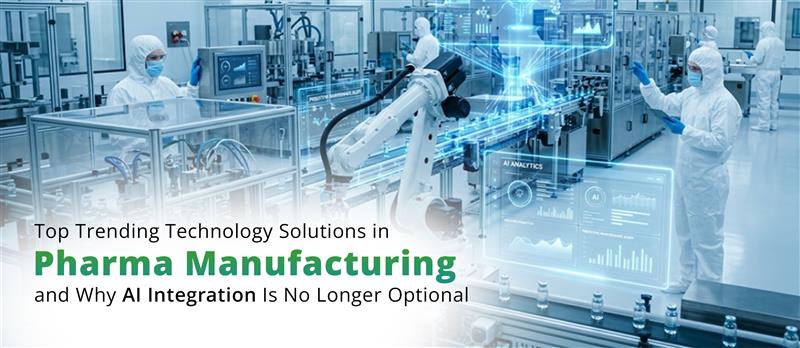
Top Trending Technology Solutions in Pharma Manufacturing and Why AI Integration Is No Longer Optional
From digital twins to predictive maintenance, discover why AI-powered technology solutions in pharma manufacturing are no longer optional today.
See Contents
- 1 Introduction
- 2 Stay Ahead with AI-Powered Pharma Manufacturing
- 3 1. Continuous Manufacturing (CM) with AI-Powered Process Control
- 4 2. Digital Twins in Pharmaceutical Manufacturing
- 5 3. Intelligent Quality Management Systems (QMS) and Automated Deviation Handling
- 6 4. Advanced Process Analytical Technology (PAT) with Machine Learning
- 7 5. Robotics and Autonomous Material Handling Systems
- 8 AI Is Reshaping Pharma Manufacturing. Are You Ready?
- 9 6. Predictive Maintenance and Asset Performance Management
- 10 7. Supply Chain Intelligence and Demand Forecasting
- 11 8. Electronic Batch Records and AI-Assisted Regulatory Intelligence
- 12 The Imperative of AI Integration: Why Pharma Manufacturing Cannot Afford to Wait
- 13 Unlock Smart Pharma Manufacturing with AI-Driven Innovation
- 14 Conclusion
Introduction
The pharmaceutical manufacturing industry is undergoing its most dramatic transformation in decades. Rising regulatory scrutiny, growing demand for precision medicines, supply chain volatility, and the unrelenting pressure to reduce time-to-market are forcing manufacturers to rethink every layer of their operations. At the center of this shift lies a powerful convergence of advanced technology solutions in pharma manufacturing, and artificial intelligence is the thread weaving them all together.
From intelligent process control systems to AI-driven quality assurance platforms, the industry is moving decisively from reactive, document-heavy workflows to proactive, data-first manufacturing ecosystems. This article explores the top trending technology solutions reshaping pharma manufacturing today and examines why deep AI integration is not simply a competitive advantage; it is an operational necessity.
Stay Ahead with AI-Powered Pharma Manufacturing
From smart automation to real-time compliance and predictive insights, AI is transforming pharma manufacturing. Discover how Yuktra helps you adopt trending technology solutions and stay future-ready.
1. Continuous Manufacturing (CM) with AI-Powered Process Control
What It Is
Continuous manufacturing replaces the traditional batch-based approach with an uninterrupted production flow, allowing raw materials to move through sequential processing stages without stopping. This paradigm shift dramatically reduces cycle times, minimizes material waste, and enables real-time quality assessment across the entire production line.
Why It Is Trending
Regulatory bodies such as the U.S. Food and Drug Administration (FDA) and the European Medicines Agency (EMA) have actively encouraged the adoption of continuous manufacturing through dedicated guidance documents. Regulatory endorsement, combined with the operational advantages of reduced footprint and faster scale-up, has pushed continuous manufacturing to the top of strategic investment lists for pharmaceutical manufacturers globally.
AI Integration in Continuous Manufacturing
AI is the intelligence layer that makes continuous manufacturing genuinely viable at scale. Machine learning models continuously analyze real-time sensor data — including temperature, pressure, particle size distribution, and blend uniformity — to detect the earliest signals of process drift before they escalate into quality deviations.
Advanced AI-driven process control systems use reinforcement learning algorithms to autonomously adjust critical process parameters (CPPs) within pre-validated design spaces, maintaining product quality without human intervention. Predictive analytics models built on historical batch data and real-time process analytics technology (PAT) data can forecast downstream quality attributes — such as tablet hardness or dissolution rate — minutes before a product reaches its final stage, enabling proactive correction rather than reactive rejection.
Key AI Applications:
- Real-time process monitoring and autonomous parameter adjustment
- Predictive Quality Attribute (CQA) forecasting using deep learning
- Anomaly detection in material flow using convolutional neural networks (CNNs)
- AI-assisted design of experiments (DoE) for continuous process validation
2. Digital Twins in Pharmaceutical Manufacturing
What It Is
A digital twin is a living, data-synchronized virtual replica of a physical manufacturing asset, process, or facility. In pharma manufacturing technology, digital twins serve as high-fidelity simulation environments where process engineers can model, test, and optimize manufacturing scenarios without disrupting actual production.
Why It Is Trending
As pharmaceutical products grow more complex — particularly biologics, cell therapies, and personalized medicines — the cost of physical process development runs into millions of dollars and years of time. Digital twins dramatically compress this timeline by enabling virtual process development, operator training, and regulatory submission preparation in a risk-free environment.
AI Integration in Digital Twins
The true power of a digital twin lies in its ability to learn and adapt, and this is where AI becomes indispensable. Machine learning models embedded within digital twins continuously ingest live operational data from IoT sensors deployed across equipment, updating the virtual model to mirror actual plant behavior in real time.
Generative AI models can simulate thousands of process scenarios within a digital twin environment to identify optimal operating windows — work that would require months of physical experimentation. AI algorithms also enable the digital twin to perform self-calibration: when sensor data indicates the physical and virtual models are diverging, the AI automatically recalibrates model parameters to restore accuracy.
Key AI Applications:
- Physics-informed neural networks (PINNs) for mechanistic model enhancement
- Generative AI for scenario simulation and design space exploration
- AI-driven root cause analysis by comparing twin model predictions vs. actual outcomes
- Natural language processing (NLP) interfaces that allow operators to query digital twin insights conversationally
3. Intelligent Quality Management Systems (QMS) and Automated Deviation Handling
What It Is
A modern Quality Management System in pharma manufacturing is far more than an electronic document repository. An intelligent QMS integrates data from laboratory information management systems (LIMS), manufacturing execution systems (MES), and enterprise resource planning (ERP) platforms to provide a unified, real-time picture of quality health across the facility.
Why It Is Trending
Regulatory agencies have intensified their data integrity expectations. Warning letters and consent decrees frequently cite inadequate deviation management, late CAPA (Corrective and Preventive Action) closures, and systemic failure to trend quality events. Manufacturers are turning to intelligent QMS platforms not only to meet compliance obligations but to build genuinely proactive quality cultures.
AI Integration in Intelligent QMS
AI transforms a QMS from a compliance filing system into an active quality guardian. Natural language processing models automatically classify incoming deviations by severity, category, and probable root cause — eliminating the subjective inconsistency that plagues manual classification. This dramatically reduces the time from deviation detection to CAPA initiation.
Machine learning models trained on thousands of historical deviation records can predict which quality events are most likely to recur, enabling risk-ranked CAPA prioritization. AI-powered pharmaceutical quality control dashboards surface leading quality indicators weeks before a formal deviation is logged, giving quality teams unprecedented foresight.
Additionally, large language models (LLMs) are increasingly being deployed to assist with regulatory writing tasks within the QMS — drafting investigation narratives, summarizing batch records for health authority submissions, and cross-referencing regulatory requirements against current quality documentation.
Key AI Applications:
- NLP-based automatic deviation classification and severity scoring
- Predictive CAPA prioritization using supervised learning models
- AI-assisted regulatory writing and submission document generation
- Pattern recognition to identify systemic quality trends across multiple sites
4. Advanced Process Analytical Technology (PAT) with Machine Learning
What It Is
Process Analytical Technology encompasses the tools and methodologies used to measure and control critical quality and performance attributes of raw materials and in-process materials during manufacturing. PAT instruments — including near-infrared (NIR) spectroscopy, Raman spectroscopy, and focused beam reflectance measurement (FBRM) — generate massive volumes of spectral and particle data in real time.
Why It Is Trending
The FDA’s 2004 PAT guidance laid the regulatory groundwork, but the technology has truly accelerated with the availability of sophisticated machine learning platforms capable of interpreting the complex, high-dimensional data that PAT instruments generate. Manufacturers are now able to pursue true real-time release testing (RTRt) — eliminating end-of-batch laboratory testing for products where PAT data comprehensively defines quality.
AI Integration in PAT
Raw NIR or Raman spectral data is inherently high-dimensional and collinear — classical statistical methods struggle to extract predictive models from it reliably. Machine learning algorithms, particularly partial least squares (PLS) regression, support vector machines (SVMs), and deep neural networks, are trained on large spectral datasets to build robust chemometric models that predict drug content, moisture, particle size, and polymorphic form in real time.
Transfer learning techniques enable chemometric models developed on one manufacturing site or piece of equipment to be efficiently adapted to a new site, dramatically reducing the spectral database needed for model development. AI also enables PAT systems to perform autonomous sensor health monitoring — identifying instrument drift or contamination by detecting unusual patterns in calibration check spectra.
Key AI Applications:
- Deep learning chemometrics for spectral interpretation
- Transfer learning for cross-site PAT model portability
- AI-driven real-time release testing (RTRt) decision engines
- Autonomous sensor drift detection and calibration management
5. Robotics and Autonomous Material Handling Systems
What It Is
Pharmaceutical manufacturing environments present unique challenges for robotics: sterility requirements, precise dispensing tolerances, complex aseptic fill-finish operations, and the need to handle an enormous variety of container formats and drug product presentations. Modern pharmaceutical robotics — from autonomous mobile robots (AMRs) to collaborative robot arms (cobots) — are increasingly central to smart manufacturing in pharma.
Why It Is Trending
Labor shortages, the growing complexity of biological and cell and gene therapy manufacturing, and the drive toward lights-out or near-lights-out manufacturing have dramatically accelerated robotic deployment in pharma facilities. Regulatory agencies have also signaled openness to fully automated aseptic manufacturing as a risk-reduction strategy, with automated visual inspection systems receiving growing regulatory acceptance.
AI Integration in Robotics
Modern pharmaceutical robotics platforms are purpose-built to run AI inference at the edge. Computer vision systems powered by convolutional neural networks perform automated visual inspection of filled vials, ampoules, and prefilled syringes at line speeds that far exceed human inspectors — identifying sub-visible particles, cosmetic defects, and fill volume anomalies with consistent, documentable precision.
Reinforcement learning enables robotic systems to develop and refine manipulation strategies autonomously — learning how to handle new container formats or packaging configurations without extensive reprogramming. AI-powered pharmaceutical automation platforms also enable dynamic task scheduling: when production priorities change or equipment goes down, AI algorithms replan robot task assignments in real time to maintain throughput.
Key AI Applications:
- CNN-based automated visual inspection for parenteral products
- Reinforcement learning for adaptive robotic manipulation
- AI-driven AMR fleet management and dynamic path planning
- Machine vision for label inspection, fill level verification, and container closure integrity
AI Is Reshaping Pharma Manufacturing. Are You Ready?
Leverage the latest technology solutions to streamline operations, ensure compliance, and drive efficiency. With Yuktra, turn complex processes into intelligent, automated workflows.
6. Predictive Maintenance and Asset Performance Management
What It Is
Predictive maintenance in pharma manufacturing uses real-time equipment sensor data and advanced analytics to anticipate equipment failures before they occur — shifting from costly reactive repairs and unplanned downtime to planned, data-driven maintenance interventions. Asset Performance Management (APM) platforms provide a unified view of equipment health, maintenance history, and reliability trends across an entire manufacturing site.
Why It Is Trending
Unplanned equipment downtime in pharmaceutical manufacturing carries consequences far beyond lost production — it can trigger batch failures, regulatory non-conformances, supply disruptions for critical medicines, and invalidation of ongoing stability studies. As manufacturers operate leaner, the risk appetite for unexpected equipment failure has shrunk considerably, driving adoption of predictive maintenance platforms as a core operational priority.
AI Integration in Predictive Maintenance
AI is the engine of predictive maintenance in pharma. Time-series machine learning models — including Long Short-Term Memory (LSTM) networks and gradient boosting algorithms — are trained on historical sensor data capturing the degradation signatures of pumps, agitators, filling needles, compression machines, and lyophilizers. These models learn the subtle, early-stage patterns that precede specific failure modes, generating advance warnings days or weeks before failure.
Prescriptive AI goes beyond prediction: it not only identifies that a pump bearing is approaching failure but recommends the optimal maintenance action, the best window in the production schedule to perform it, and the required spare parts — considering current production commitments, planned maintenance resources, and spare parts inventory.
Key AI Applications:
- LSTM and transformer models for time-series equipment health forecasting
- Unsupervised anomaly detection for novel failure mode identification
- Prescriptive maintenance recommendation engines
- AI-driven integration with computerized maintenance management systems (CMMS) for automated work order generation
7. Supply Chain Intelligence and Demand Forecasting
What It Is
Pharmaceutical supply chains are extraordinarily complex, spanning API sourcing from geographically concentrated suppliers, global contract manufacturing networks, cold chain logistics for biologics, and highly regulated distribution channels. Supply chain intelligence platforms integrate data from ERP systems, supplier portals, market demand signals, and real-world patient data to provide end-to-end supply chain visibility and resilience.
Why It Is Trending
The COVID-19 pandemic exposed catastrophic fragility in global pharmaceutical supply chains, triggering a wave of supply chain redesign, reshoring initiatives, and technology investment. Regulatory agencies in multiple jurisdictions have introduced drug shortage reporting requirements and supply chain transparency obligations, adding regulatory impetus to the business case for supply chain intelligence platforms.
AI Integration in Supply Chain
AI-driven demand forecasting models leverage a far richer signal set than traditional statistical forecasting methods — incorporating prescription trend data, epidemiological models, payer formulary changes, competitive product launches, and even social determinants of health to generate granular, market-specific demand forecasts. These multi-factor AI models substantially outperform legacy time-series forecasting in accuracy, particularly for specialty and orphan drug products with high demand volatility.
Natural language processing models continuously monitor external news feeds, supplier financial disclosures, regulatory agency communications, and geopolitical event databases to identify supply chain risk signals — such as a key API supplier facing regulatory action or a raw material shortage in a specific geography — before they crystallize into actual supply disruptions.
Key AI Applications:
- Multi-factor AI demand forecasting integrating market, clinical, and patient data
- NLP-based supplier risk monitoring and early warning systems
- AI-driven inventory optimization balancing service levels against carrying costs
- Generative AI for supply chain scenario planning and disruption simulation
8. Electronic Batch Records and AI-Assisted Regulatory Intelligence
What It Is
Electronic Batch Records (EBRs) replace paper-based manufacturing records with digital systems that capture real-time process data, operator actions, equipment readings, and in-process test results directly within the manufacturing execution system. Regulatory intelligence platforms aggregate, analyze, and interpret guidance documents, inspection reports, and enforcement actions from health authorities worldwide.
Why It Is Trending
Data integrity has become the dominant theme of pharmaceutical regulatory inspections globally. Paper-based batch records are inherently vulnerable to transcription errors, data backdating, and unauthorized alterations. EBR platforms dramatically reduce data integrity risk while simultaneously creating rich structured datasets that power AI-driven analytics — a dual benefit that makes the business case compelling.
AI Integration in EBR and Regulatory Intelligence
AI-powered EBR platforms perform real-time batch record review, automatically flagging anomalies such as out-of-sequence entries, entries made outside validated environmental conditions, or data values that deviate from expected process signatures. This shifts batch review from a retrospective, post-production activity to a concurrent, proactive quality control function.
On the regulatory intelligence side, large language models trained on regulatory corpora can parse and synthesize thousands of pages of FDA guidance documents, EMA reflection papers, ICH guidelines, and inspection observation databases to provide manufacturers with precise, context-specific regulatory intelligence. These AI systems can identify when a contemplated process change would trigger a Prior Approval Supplement rather than an Annual Product Review — preventing costly regulatory submission errors.
Key AI Applications:
- Real-time AI batch record review with anomaly detection
- NLP extraction of process parameters from legacy paper records for digitization
- LLM-powered regulatory intelligence and submission strategy advisory tools
- AI-assisted content authoring for CTD (Common Technical Document) submissions
The Imperative of AI Integration: Why Pharma Manufacturing Cannot Afford to Wait
Each of the technology solutions discussed above delivers meaningful value in isolation. But the transformative potential of technology solutions in pharma manufacturing is only fully realized when AI acts as the unifying intelligence layer connecting them.
Consider a fully AI-integrated manufacturing facility: the digital twin simulates process behavior before production starts; AI-controlled PAT instruments monitor quality in real time; an AI-powered QMS flags early quality signals; predictive maintenance algorithms ensure the equipment never fails unexpectedly; and an AI demand forecasting engine ensures the right materials are available at the right time. This is not a futuristic scenario — it is the operational reality being built today by leading pharmaceutical manufacturers.
The barriers to AI integration are real: data silos, legacy infrastructure, regulatory uncertainty around AI validation, and talent gaps in data science and machine learning. But these are solvable challenges, and the cost of not solving them is rising rapidly. Manufacturers who delay AI integration face widening competitive disadvantages in operational efficiency, product quality, and regulatory performance.
The FDA’s emerging framework for AI/ML-enabled pharmaceutical manufacturing — including its ongoing work on model risk management, AI-based real-time release testing, and the use of AI in GMP-regulated environments — signals regulatory acceptance of AI as a core manufacturing technology, not a fringe experiment. Industry groups including ISPE, PDA, and ICH are actively developing technical frameworks to guide AI implementation in regulated manufacturing, further reducing the ambiguity that has slowed adoption.
Unlock Smart Pharma Manufacturing with AI-Driven Innovation
Harness cutting-edge technologies like AI, automation, and real-time analytics to optimize production, ensure regulatory compliance, and boost operational efficiency. Yuktra empowers you to lead the future of intelligent pharma manufacturing.
Conclusion
The pharmaceutical manufacturing landscape is being fundamentally reshaped by a new generation of technology solutions in pharma manufacturing — from continuous manufacturing and digital twins to intelligent QMS platforms and AI-powered supply chain intelligence. Across every one of these domains, artificial intelligence is not merely an add-on feature; it is the capability that determines whether these technologies deliver their full potential or fall short.
Manufacturers who approach pharma digital transformation strategically — building unified data infrastructures, investing in AI talent, engaging regulators proactively, and deploying AI across interconnected manufacturing systems — are positioning themselves to lead the next decade of pharmaceutical innovation. Those who treat AI as a future consideration risk being defined by the decisions they defer today.
The integration of AI into pharmaceutical manufacturing is not a question of if. For forward-looking organizations, it is unambiguously a question of how fast.
Recommend reading Productivity Improvement in Pharmaceutical Industry. Further, connect with us for more details.