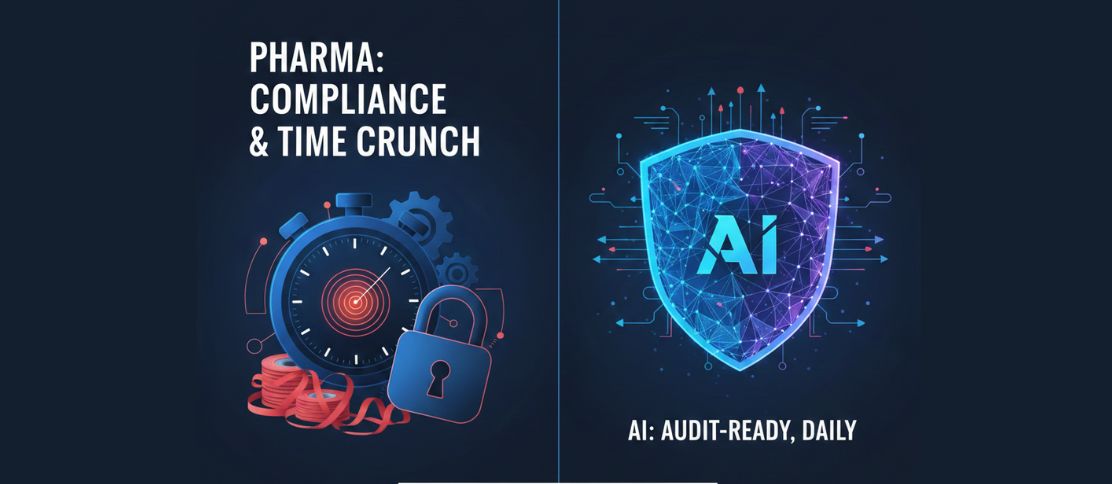
Pharma Compliance Is Not Just a Regulatory Challenge. It Is a Time Crisis. Why AI Is the Only Sustainable Solution
Explore how AI is redefining pharma compliance, enabling smarter oversight, greater operational resilience, and a future ready regulatory framework built for scale.
Pharma compliance has always been associated with regulations, inspections, and documentation. Most discussions around pharma compliance focus on regulatory frameworks, warning letters, audit observations, and corrective actions. But there is a deeper issue that is often ignored.
Across manufacturing plants, quality units, regulatory affairs departments, and validation teams, professionals are not struggling because they do not understand the rules. They are struggling because there are not enough hours in the day to execute every compliance requirement with precision, consistency, and speed.
This is where AI is emerging as the only sustainable solution. Not as a replacement for quality professionals, but as a system that removes the time bottleneck inside pharma compliance operations.
See Contents
- 1 Understanding the True Nature of Pharma Compliance
- 2 Ready to Strengthen Your Pharma Compliance with AI?
- 3 Why Pharma Compliance Has Become a Time Crisis
- 4 The Difference Between Compliant and Continuously Audit-Ready
- 5 How AI Solves the Time Problem in Pharma Compliance
- 6 Validation and AI in GxP Environments
- 7 Strategic Benefits of AI-Driven Pharma Compliance
- 8 The Future of Pharma Compliance Is Continuous and Intelligent
- 9 Ready to Strengthen Your Pharma Compliance with AI?
- 10 Conclusion: AI Is the Only Sustainable Solution
Understanding the True Nature of Pharma Compliance
At its core, pharma compliance ensures that every product released to patients is safe, effective, and manufactured under controlled conditions. It spans Good Manufacturing Practices, Good Clinical Practices, Good Laboratory Practices, electronic records requirements, data integrity controls, and global regulatory standards.
Pharma compliance covers:
- Batch record review and release
- Deviation investigation and root cause analysis
- Corrective and Preventive Actions management
- Change control oversight
- Supplier qualification and monitoring
- Validation of equipment, systems, and processes
- Electronic records and audit trail integrity
- Employee training and role-based qualification
Each of these areas requires documentation, traceability, approvals, and monitoring. The complexity is intentional because patient safety depends on it.
However, the volume of work required to maintain pharma compliance has grown dramatically in the last decade.
Manufacturing has become more digitized. Data generation has increased exponentially. Global supply chains have expanded. Regulatory inspections are more data-driven. Expectations for transparency and traceability are higher than ever.
Pharma compliance today is not just about meeting regulations. It is about keeping up with the pace of regulated operations.
Ready to Strengthen Your Pharma Compliance with AI?
Build a resilient, future-ready compliance ecosystem designed to handle increasing regulatory pressure with intelligence and scale.
Schedule a Consultation Now!
Why Pharma Compliance Has Become a Time Crisis
The biggest misconception is that pharma compliance failures happen because teams lack knowledge. In reality, most compliance gaps occur because time runs out.
Consider the operational reality inside a pharmaceutical company.
Every production batch generates documentation that must be reviewed. Every deviation must be investigated within defined timelines. Also, every CAPA must be tracked until closure.
Every SOP must be reviewed periodically. Every system update requires validation documentation. Additionally, every employee must maintain up-to-date training records.
Now multiply that by multiple product lines, multiple manufacturing sites, global distribution networks, and continuous inspections.
The workload compounds quickly.
Quality teams are often responsible for reviewing thousands of pages of documentation each month. Manual review processes consume significant time. Spreadsheet tracking systems require constant updates. Email-based workflows create delays and miscommunication.
Pharma compliance becomes reactive instead of proactive.
Instead of continuously monitoring risks, teams scramble before inspections. Instead of analyzing trends in real time, they generate quarterly reports. Also, instead of preventing compliance drift, they correct it after it happens.
This is not a failure of discipline. It is a failure of time capacity.
Pharma compliance requires constant vigilance, but human bandwidth is limited.
The Difference Between Compliant and Continuously Audit-Ready
There is an important distinction in pharma compliance: being compliant versus being continuously audit-ready.
Many organizations operate in cycles. For most of the year, compliance activities proceed at a steady pace. When the inspection notice arrives, the intensity increases dramatically. Open CAPAs are reviewed urgently. Training records are reconciled. Audit trails are double-checked. Documentation gaps are closed.
During that period, pharma compliance looks strong.
But this surge model is unsustainable. It creates stress, burnout, and hidden risk.
Continuous audit readiness means that on any given day, documentation is current, deviations are under control, CAPAs are progressing on time, and training compliance is intact. It means that inspection preparation does not require emergency mobilization.
Achieving this level of pharma compliance manually is extremely difficult in modern high-volume environments.
This is where AI becomes critical.
How AI Solves the Time Problem in Pharma Compliance
AI does not interpret regulations independently or make regulatory decisions without oversight. Instead, AI reduces the time burden associated with monitoring, tracking, and analyzing compliance data.
Here are the technical areas where AI transforms pharma compliance.
1. Intelligent CAPA Management
Corrective and Preventive Actions are central to pharma compliance. Each CAPA has deadlines, root cause documentation, impact assessments, and verification steps.
AI systems can:
- Continuously monitor open CAPAs and flag aging risks
- Predict which CAPAs are likely to miss deadlines based on historical patterns
- Detect recurring root causes across departments
- Prioritize high-risk CAPAs for leadership attention
Using machine learning models trained on historical deviation and CAPA datasets, organizations can move from reactive closure to predictive oversight.
This strengthens pharma compliance by preventing backlog accumulation and reducing repeat observations.
2. Real-Time Deviation Trend Analysis
Traditional deviation trend analysis is periodic. AI makes it continuous.
By applying pattern recognition and anomaly detection algorithms to deviation databases, AI can identify:
- Recurring equipment-related deviations
- Operator-specific trends
- Process drift over time
- Cross-site systemic issues
Instead of waiting for quarterly reviews, pharma compliance teams receive real-time alerts when deviation clusters begin forming.
This reduces regulatory risk and supports preventive action.
3. Automated Document Control and SOP Monitoring
Document control is one of the most time-consuming aspects of pharma compliance.
AI-powered systems can:
- Monitor document review cycles automatically
- Detect inconsistencies between active processes and approved procedures
- Flag outdated SOP references within batch records
- Route documents for review based on risk prioritization
Natural language processing can analyze document content and identify missing elements required under regulatory standards.
This ensures pharma compliance documentation remains accurate and synchronized without constant manual supervision.
4. Audit Trail Monitoring and Data Integrity Surveillance
Regulations require secure electronic records and tamper-evident audit trails.
AI systems can analyze large volumes of audit trail logs to detect:
- Unusual access patterns
- Backdated entries
- Unauthorized data modifications
- Suspicious deletion patterns
Using anomaly detection models, AI highlights risks that human reviewers may overlook due to scale.
Data integrity is a core pillar of pharma compliance, and AI strengthens it by operating continuously.
5. Training Compliance Automation
Training management directly impacts pharma compliance. An unqualified employee performing regulated tasks can lead to inspection findings.
AI-integrated learning management systems can:
- Map job roles to required training automatically
- Identify gaps in certification
- Prevent task assignments if training is expired
- Predict upcoming training bottlenecks
This ensures that training compliance is maintained daily rather than corrected before audits.
Follow the link to check details on Key GxP and Regulatory Compliance Requirements for Pharma Software.
Validation and AI in GxP Environments
One common concern is whether AI can operate within GxP-regulated environments.
The answer lies in validation.
AI systems used in pharma compliance must undergo validation similar to other computerized systems. This includes:
- User Requirement Specifications
- Functional Specifications
- Installation Qualification
- Operational Qualification
- Performance Qualification
- Ongoing performance monitoring
AI outputs must be explainable, traceable, and documented. Decision logic must be transparent. Risk assessments must be performed before deployment.
When implemented properly, AI strengthens pharma compliance instead of compromising it.
Strategic Benefits of AI-Driven Pharma Compliance
Solving the time crisis inside pharma compliance produces measurable business outcomes.
Organizational experience:
- Faster CAPA closure rates
- Reduced inspection preparation time
- Lower repeat deviation frequency
- Improved data integrity assurance
- Better cross-site compliance visibility
- Reduced burnout in quality teams
Most importantly, compliance becomes embedded into daily operations rather than activated during inspection cycles.
Pharma compliance transforms from reactive defense into continuous assurance.
The Future of Pharma Compliance Is Continuous and Intelligent
Regulatory bodies are increasingly adopting data analytics in inspections. Remote audits and digital data requests are becoming common. Inspectors expect immediate access to accurate, structured information.
In this environment, manual systems will struggle to maintain pace.
AI-supported pharma compliance aligns with the direction regulators are moving toward: structured data, traceability, and risk-based oversight.
Organizations that recognize pharma compliance as a time optimization challenge will build systems that sustain continuous readiness.
Ready to Strengthen Your Pharma Compliance with AI?
Build a resilient, future-ready compliance ecosystem designed to handle increasing regulatory pressure with intelligence and scale.
Schedule a Consultation Now!
Conclusion: AI Is the Only Sustainable Solution
Pharma compliance is not weakening because regulations are unclear. It is under strain because operational speed has exceeded manual capacity.
The industry is fighting two battles simultaneously. It is managing regulatory complexity. And it is racing against time. AI addresses the time crisis directly. It monitors continuously. It detects patterns instantly. Also, it prioritizes intelligently. It reduces human administrative burden.
Quality professionals remain responsible for judgment, investigation, and decision-making. AI ensures they have the time to do it properly. Pharma compliance in the future will not be defined by last-minute audit preparation. It will be defined by continuous, AI-supported readiness.
In a world where inspections are unpredictable and expectations are rising, AI is not an optional enhancement. It is the only sustainable solution for modern pharma compliance.
Further, check the details on Revised Schedule M.
